What Makes a Texas Mold Assessment Report Different
Texas operates under the Texas Mold Assessment and Remediation Rules (TMARR), administered by the Texas Department of Licensing and Regulation. Your assessor must hold a TDLR Mold Assessment Technician or Consultant license, and the company must carry a separate Mold Assessment Company license. You can verify both at the TDLR mold license lookup before the inspection even happens.
The legal separation between assessment and remediation companies exists for one reason: to keep your report honest.
The technician who tests your home cannot be the same company that fixes it. This protects you from inflated remediation scopes driven by profit motive rather than actual necessity.
A legitimate Texas assessment report will include the assessor's license number, the date of inspection, detailed observations of water damage and visible mold, moisture meter readings from suspect areas, and — if sampling occurred — laboratory analysis of air or surface samples. Reports missing any of these components should raise immediate questions about thoroughness and compliance.
Essential Components of a Compliant Texas Mold Assessment Report:
- TDLR license number of both assessor and company
- Date and time of inspection
- Room-by-room visual observations
- Moisture meter readings with specific percentages
- Laboratory analysis (if sampling was performed)
- Photo documentation of affected areas
- Identified moisture sources
- Specific remediation recommendations
The Visual Inspection Section: What They Actually Saw

Before any lab results appear, your report should document what the assessor observed during the walkthrough. This section lists water stains, visible mold growth, musty odors, condensation patterns, and moisture readings from non-invasive meters.
In Texas homes built on slab-on-grade foundations — the dominant construction type across Houston, Dallas-Fort Worth, Austin, and San Antonio — plumbing leaks under the slab create hidden moisture that shows up as unexplained moisture readings in flooring or baseboards.
Look for specific room-by-room documentation with moisture percentages. Wood moisture content above 16-20% typically indicates active water intrusion. Drywall readings above 1.0% on a pin-type meter suggest moisture problems. The best reports include photos showing exactly where moisture was detected, not just narrative descriptions.
Many homeowners discover their attic insulation is damp or their pier-and-beam crawl space (common in older Houston, Dallas, and Fort Worth neighborhoods) shows condensation on floor joists — conditions the visual inspection should capture before sampling even begins.
If your report jumps straight to lab results without documenting the physical evidence that prompted sampling, you're missing critical context about why testing happened in those specific locations.
Understanding Air Sample Results
Air sampling measures airborne mold spore concentrations in specific rooms compared to outdoor baseline levels. The lab report will list spore counts per cubic meter of air (spores/m³) for each mold genus detected — Cladosporium, Penicillium, Aspergillus, and others.
Here's what matters: indoor spore counts should be lower than outdoor counts for the same mold types.
If your living room shows 8,000 spores/m³ of Penicillium but outdoor air measured 1,200 spores/m³, you have an indoor amplification problem. That gap signals active mold growth somewhere in that room, even if you can't see it behind walls or in HVAC ductwork.
There are no federal health-based standards for mold spore levels in air — the EPA and CDC explicitly state this.[1][2] Your report won't tell you whether 5,000 spores/m³ is "safe" because no regulatory agency has defined that threshold. Instead, assessors interpret results by comparing indoor to outdoor ratios, looking for elevated levels of certain "indicator molds" like Stachybotrys (black mold) or Chaetomium (both associated with chronic water damage), and considering the diversity of species present.
A sample showing high counts of a single mold type suggests active colonization. A sample with trace amounts of many types typically reflects normal background spores entering from outdoors.
Texas assessors familiar with regional climate patterns know that Cladosporium dominates outdoor air during humid summer months (May-October), so elevated indoor Cladosporium during that season might simply reflect inadequate HVAC filtration rather than hidden growth. Context matters.
Surface Sampling: Tape Lifts and Swabs
Surface samples use clear tape pressed against suspected mold growth or cotton swabs rubbed across stained areas. The lab analyzes what adhered to the tape or swab, identifying mold genera and sometimes species.
Surface sampling confirms whether that black staining on your bathroom ceiling is actually mold or just dirt and soap residue. It also identifies the specific mold type growing on that mystery patch behind your washing machine.
If the report shows Stachybotrys chartarum (black mold) or Chaetomium — both indicating prolonged water damage and cellulose breakdown — you're looking at a moisture problem that's been ongoing for weeks or months, not a recent issue.
One critical limitation: surface samples tell you what's growing in that exact spot, but they don't reveal how much mold exists overall or whether airborne spores are circulating throughout the home. A positive surface sample confirms mold presence; it doesn't tell you the scope of remediation needed. For that, you need air sampling or extensive moisture mapping.
Surface results appear as genus and species names with relative abundance ratings (few, moderate, many) or actual spore counts per square centimeter.
Many homeowners panic seeing "Stachybotrys detected" without understanding that a small isolated patch requires different remediation than widespread wall cavity contamination. The assessor's recommendations section should clarify scope based on both the sample results and the visual moisture investigation.
| Sample Type | What It Reveals | What It Misses | Best Used For |
|---|---|---|---|
| Air Sampling | Airborne spore concentration; indoor vs. outdoor comparison; overall contamination level | Exact location of growth; hidden mold behind barriers | Determining if spores are circulating; baseline comparisons |
| Surface Sampling | Specific mold species; confirms visible growth is actually mold | Total spore load in air; contamination scope | Identifying mold type on visible stains; targeted species confirmation |
| Moisture Mapping | Location and severity of water intrusion; source identification | Mold species present; spore counts | Finding the root cause; planning moisture remediation |
Moisture Mapping and the Real Source Problem
The most valuable part of your assessment report isn't the mold species list — it's the moisture map showing exactly where water intrusion is happening.
Mold is a symptom. Moisture is the disease.
Texas homes face unique moisture challenges tied to expansive clay soil (dominant across the Blackland Prairie, Gulf Coast Plain, and South Texas) and slab-on-grade construction. Clay soil swells when saturated and shrinks when dry, creating foundation movement that cracks slabs and shifts plumbing. Copper and PEX lines running under the slab develop pinhole leaks or joint failures, releasing water that migrates through soil and wicks into flooring, baseboards, and wall cavities.
You won't see the leak — you'll see elevated moisture readings in interior rooms nowhere near plumbing fixtures.
Your assessor should have used a pin-type or pinless moisture meter to scan floors, walls, and ceilings in suspect areas. Thermal imaging cameras (infrared) can reveal temperature differences caused by evaporating moisture hidden behind drywall. The moisture mapping section should document readings room by room, identifying the highest concentrations and correlating them with water sources: HVAC condensate drain pan overflow, roof leaks, plumbing failures, or exterior drainage problems pushing groundwater against the foundation.
If your report lists elevated spore counts but doesn't pinpoint the moisture source with specific meter readings and locations, the assessment is incomplete.
You need to know where the water is coming from before remediation can succeed. Otherwise, you're treating mold while leaving the leak active — guaranteeing recurrence within months.
Houston homes that flooded during Hurricane Harvey often developed chronic moisture issues from foundation damage and saturated soil that never fully dried. Assessors familiar with post-Harvey properties know to check for residual moisture in slab edges and perimeter walls even years after the event.
Interpreting Remediation Recommendations
The final section translates findings into action. Remediation recommendations should be specific, room-by-room, and proportionate to the contamination level.
The NIH's Standard Operating Procedures for moisture and mold remediation emphasize scaling response to the extent of damage: small areas (under 10 square feet) often need simple cleaning, while large contamination (over 100 square feet) or HVAC system involvement requires professional remediation with containment and air filtration.[3]
Your Texas report should reference IICRC S520 standards (the industry protocol for mold remediation) and may categorize contamination as Condition 1 (normal), Condition 2 (moderate), or Condition 3 (extensive). Condition 1 requires no remediation. Condition 2 might involve removing and replacing water-damaged drywall in a single bathroom. Condition 3 could mean sealing off entire rooms, removing multiple wall cavities of insulation, and running HEPA filtration for days.
Watch for vague language like "recommend professional remediation" without specifics on scope, affected square footage, or materials to remove.
A detailed recommendation will say "remove and dispose of water-damaged drywall and fiberglass insulation in master bathroom (approximately 40 square feet), address plumbing leak behind shower valve, apply antimicrobial coating to framing, and re-insulate with closed-cell spray foam to prevent recurrence."
Because TDLR rules prohibit the assessor from performing remediation, the report should not include pricing. It should describe what needs to happen, and you'll get separate bids from TDLR-licensed remediation contractors. This separation lets you shop multiple quotes knowing the scope was defined by an independent party, not the company hoping to win your business.
Some homeowners report receiving assessment reports that jump straight to expensive remediation without documenting sufficient evidence — no photos, no clear moisture source, just elevated spore counts and a referral to a "preferred" contractor.
That pattern violates the spirit of TDLR's conflict-of-interest protections. If your report feels like a sales pitch rather than an objective investigation, get a second opinion from another licensed assessor.
Critical Warning: Any assessor who recommends a specific remediation company by name or offers to "coordinate" remediation work is violating TMARR regulations. This conflict-of-interest prohibition exists to protect you — your assessment should provide objective findings and scope, nothing more. Get separate bids from multiple TDLR-licensed contractors based on the report's recommendations.
What the Lab Analysis Actually Shows
Laboratory analysis accompanies air and surface samples. The lab receives the collection media (cassettes for air samples, tape or swabs for surface samples), processes it under a microscope, identifies mold genera and species, counts spores, and reports results back to the assessor.
Your report will include a lab summary listing each sample location, the mold types identified, and quantified spore counts. Labs use different formats — some report total spore counts, others break down counts by individual genera, and most include a note about detection limits and analytical methods.
Many Texas assessors use AIHA-accredited labs like EMSL Analytical or ESPI Labs for consistent, defensible results.
The lab doesn't interpret findings — that's the assessor's job. Lab technicians identify what's present; assessors explain what it means for your home. If your report dumps raw lab data on you without an interpretation section explaining indoor/outdoor comparisons or which molds are concerning, you're getting half an assessment.
One common source of confusion: trace amounts of many mold types appearing on a single sample.
This usually reflects environmental contamination during sample collection or normal background spores, not active colonization. Assessors experienced with Texas humidity patterns know the difference between a "dirty" sample (collected near an open window in August) and a true amplification problem.

Indoor vs. Outdoor Comparisons and Why They Matter
Every proper mold assessment includes an outdoor control sample collected the same day as indoor samples. This baseline shows what mold spores naturally exist in the local environment, accounting for seasonal variation, recent rain, and regional vegetation.
Texas outdoor air typically contains high Cladosporium and Ascospores during warm, humid months. Outdoor counts can exceed 50,000 spores/m³ on a spring day after thunderstorms.
If your indoor living room measures 3,000 spores/m³ of Cladosporium and outdoor air shows 45,000 spores/m³, that's not a contamination problem — that's evidence your HVAC filtration is doing its job.
But if indoor counts exceed outdoor counts for the same mold type by more than a factor of two, or if indoor air contains molds not detected in outdoor samples (like Stachybotrys or Chaetomium), you have amplification. Amplification means active growth is releasing spores inside your home faster than outdoor sources would account for.
Assessors who skip the outdoor control sample or collect it days later (when weather conditions changed) are cutting corners.
The comparison is meaningless without same-day data. If your report lacks outdoor results, the spore count numbers alone can't tell you much — you're missing the reference point that makes interpretation possible.
Recognizing Indicator Molds and Water-Damage Species
Not all molds carry the same implications. Cladosporium, Penicillium, and Aspergillus are cosmopolitan — found nearly everywhere indoors and out. High concentrations suggest moisture problems, but their presence alone doesn't scream "crisis."
Then you have indicator molds associated with specific conditions.
Stachybotrys chartarum (black mold) grows on cellulose materials (paper-faced drywall, cardboard, ceiling tiles) that remain wet for extended periods — think weeks of slow plumbing leaks or chronic condensation from failed vapor barriers in new construction spray-foamed walls. Chaetomium thrives under the same conditions and often appears alongside Stachybotrys in severely water-damaged buildings.
Fusarium, Acremonium, and Ulocladium also signal persistent moisture. If your report identifies any of these, you're looking at chronic water intrusion that allowed colonization over time. The moisture source isn't a one-time spill — it's an ongoing leak, failed waterproofing, or condensation cycle that hasn't been addressed.
Texas assessors familiar with local construction know that spray foam insulation installed improperly (common in rapid new-construction developments across Austin, San Antonio, and DFW suburbs) traps moisture against sheathing, creating ideal conditions for Stachybotrys and Chaetomium growth hidden inside wall cavities. Thermal imaging during the assessment might reveal temperature anomalies indicating trapped moisture even when the drywall looks fine.
If your report shows Stachybotrys or other water-damage indicators, remediation will require more than surface cleaning — you'll likely need wall cavity mold removal and comprehensive moisture control to prevent recurrence.
When Reports Recommend Post-Remediation Verification
A thorough assessment report will recommend post-remediation verification (also called clearance testing) after remediation completes. Verification sampling confirms that spore counts returned to normal levels and the moisture source was successfully addressed.
TDLR rules allow the original assessor to perform clearance testing even though they can't do the remediation.
This makes sense — the same professional who documented the baseline conditions is best positioned to confirm the problem was solved. Expect clearance testing to cost $300-$600 depending on the number of samples needed.
Clearance testing uses the same air sampling methods as the initial assessment, comparing post-remediation indoor spore counts to outdoor baseline levels. If indoor counts now match or fall below outdoor levels, and previously detected indicator molds (like Stachybotrys) are absent, the remediation succeeded. If counts remain elevated or indicator molds persist, additional work is needed before the space is safe to reoccupy.
Some remediation contracts include clearance testing in the total price; others charge separately. Clarify this upfront to avoid surprise costs.
Homeowners who skip clearance testing have no objective proof the remediation worked — just the contractor's word. That becomes a problem if you're selling the home and buyers request documentation, or if insurance claim mold services require proof of proper remediation for reimbursement.
What Good Reports Include That Bad Ones Skip
After reviewing hundreds of homeowner experiences, clear patterns separate valuable reports from inadequate ones.
Good reports include photos showing every moisture anomaly, visible mold growth, and sample collection location. You should be able to match each lab result to a specific documented area.
Good reports provide moisture meter readings with specific percentages or moisture content values, not just "elevated" or "concerns noted." Numerical data lets you track improvements after repairs and gives remediation contractors concrete targets for drying.
Good reports explain the probable moisture source based on physical evidence — not speculation, but documented observations like water stains above a plumbing chase, condensation on ductwork in an unconditioned attic, or soil moisture migration through slab edges in areas with poor exterior drainage.
Without source identification, remediation becomes guesswork.
Bad reports jump to conclusions without supporting data — claiming to identify the mold source when photos and moisture readings don't back it up. Bad reports lack indoor/outdoor spore comparisons or collect outdoor samples on different days under different weather conditions. Bad reports recommend expensive remediation for normal background spore levels or fail to distinguish trace contamination from active amplification.
If your report feels vague, incomplete, or like it's steering you toward one specific remediation company without objective justification, trust your instincts.
Texas has enough TDLR-licensed assessors that getting a second opinion is always an option. Verify the assessor's license status, check for any disciplinary actions through TDLR, and confirm their company carries professional liability and pollution liability insurance (required under TMARR but sometimes ignored by fly-by-night operators).
How to Use Your Report to Get Accurate Remediation Bids
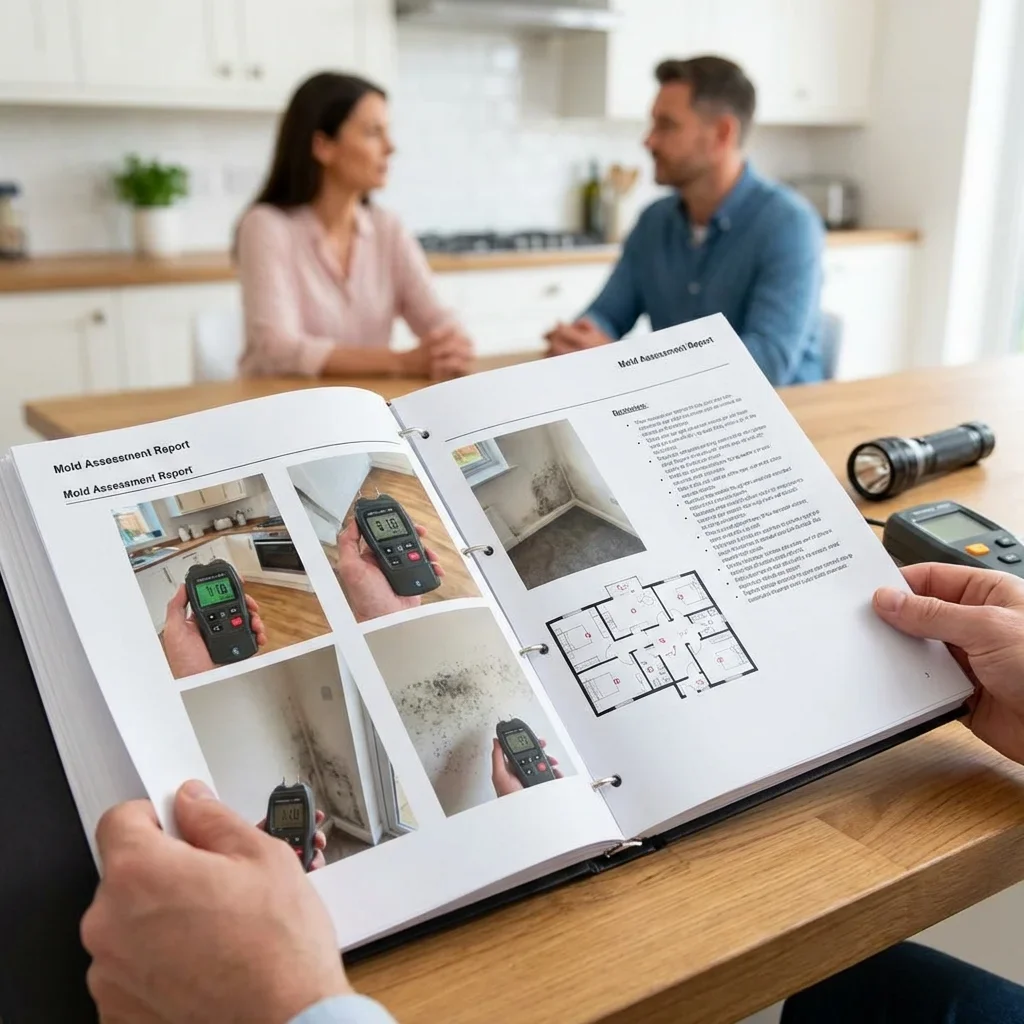
Once you have a complete assessment report, you're ready to solicit remediation bids from TDLR-licensed contractors. The report defines the scope, so contractors should be bidding on the same work — that makes price comparisons meaningful.
Provide the full report to at least three remediation companies.
Ask each contractor how their proposed scope aligns with the assessor's recommendations. If a bid includes work the report didn't mention, ask why — there might be legitimate reasons (pre-existing conditions discovered during the walkthrough), or it might be scope creep designed to inflate the price.
Similarly, if a bid omits work the assessor recommended, ask for clarification. Cutting corners on moisture remediation — like failing to address the plumbing leak before removing mold-damaged drywall — guarantees recurrence. Some contractors low-ball bids by skipping essential steps.
Verify each bidding contractor holds a valid TDLR Mold Remediation Contractor license and the company carries a Mold Remediation Company license. Check for general liability, workers' compensation (not legally required in Texas but a sign of professionalism), and pollution liability insurance.
Ask whether they follow IICRC S520 standards and whether clearance testing is included or added separately.
Homeowners who choose remediation companies based on the lowest bid alone often regret it when work quality suffers or the mold returns within months. The best value comes from contractors who demonstrate understanding of your specific moisture problem, provide detailed work plans matching the assessment scope, and commit to clearance testing upon completion.
When to Question Your Assessment Report
Certain red flags warrant skepticism.
If your report arrived within 24 hours of the inspection without lab results, something's wrong — labs typically require 2-5 business days to process samples. Instant reports either skipped sampling or are based on visual observation alone, which the CDC notes is less reliable than proper testing when health concerns exist.[2]
Reports recommending immediate remediation for common bathroom molds like Cladosporium found on grout or shower caulk should be questioned. Those molds appear in virtually every humid bathroom; their presence doesn't automatically justify professional remediation unless moisture meters show structural moisture intrusion or air samples reveal amplification.
Reports that fail to identify moisture sources but recommend extensive remediation are problematic.
You can't fix mold without fixing moisture — any assessor who focuses only on the symptom without documenting the cause is providing incomplete service.
If your assessor recommends a specific remediation company by name (especially if they offer to "coordinate" the work for you), that's a TMARR violation. Assessors can explain what needs to happen; they cannot steer you to particular contractors or receive referral fees. That prohibition exists specifically to protect you from conflicts of interest.
Finally, reports showing extremely high spore counts (hundreds of thousands of spores/m³) in occupied living spaces where no visible mold exists should prompt questions.
Catastrophic contamination produces visible evidence — you'd see it, smell it, or experience health symptoms. If the numbers don't match the physical reality, lab error or sample contamination might be at play. Requesting split samples (where the same cassette is analyzed by two independent labs) can resolve these discrepancies.
Next Steps After Receiving Your Report
If your report confirms mold growth and identifies moisture sources, you'll move through three phases: moisture remediation, mold remediation, and verification.
Moisture comes first — repair the roof leak, fix the plumbing, improve drainage, adjust HVAC settings, or address whatever's causing water intrusion. No amount of mold removal works if the moisture source remains active.
Many Texas homeowners dealing with under-slab plumbing leaks face difficult decisions: reroute plumbing through the attic (expensive but permanent), inject epoxy sealants into the slab leak (cheaper but temporary), or live with elevated moisture and manage it through dehumidification (not ideal for health). Your assessment report can't make that choice for you, but it should document the moisture severity and location precisely enough that plumbers can target repairs without exploratory demolition.
Once moisture is controlled, licensed remediation contractors can remove contaminated materials, clean affected surfaces, and restore the space following IICRC S520 protocols. Containment barriers, HEPA filtration, and proper disposal of moldy materials separate professional remediation from DIY attempts that spread spores throughout the house.
After remediation, clearance testing confirms success.
Only then do you rebuild, repaint, and return the space to normal use.
If your report shows normal conditions (indoor spore counts at or below outdoor levels, no indicator molds, no elevated moisture readings), you can skip remediation and focus on prevention. Maintain HVAC systems to control humidity below 60%, address plumbing leaks immediately, ensure proper ventilation in bathrooms and kitchens, and monitor basements or crawl spaces for seasonal moisture changes.
An annual follow-up inspection costs far less than emergency remediation after neglect allows small problems to grow.
Understanding Costs and Insurance Implications
Assessment costs in Texas typically range from $400 to $800 for a standard residential inspection with air and surface sampling. More extensive sampling (whole-house investigations with multiple rooms) can exceed $1,000. Clearance testing adds another $300-$600.
These costs are generally not covered by homeowners insurance unless the mold resulted from a covered peril (like a sudden plumbing failure or storm damage). Gradual moisture problems from deferred maintenance don't qualify.
Before paying for assessment, check your policy and consider whether insurance claim mold services might apply to your situation.
If your assessment reveals extensive contamination requiring professional remediation, costs can range from $1,500 for small isolated areas to $15,000+ for whole-house problems involving HVAC systems, wall cavities, and structural drying. Understanding what your report actually says helps you anticipate costs and avoid contractors who inflate remediation scopes beyond what's necessary.
Texas homeowners who discovered mold after Hurricane Harvey flooding often faced denials when insurers determined the mold resulted from flood damage (excluded under standard policies) rather than wind damage (covered).
Assessment reports documenting the moisture source and timeline became critical evidence in those disputes. If your situation involves storm damage, make sure your assessor documents the sequence of events and moisture intrusion patterns with enough detail to support an insurance claim if needed.
- US EPA. "Are there federal regulations or standards regarding mold?." https://www.epa.gov/mold/are-there-federal-regulations-or-standards-regarding-mold. Accessed April 02, 2026.
- CDC. "Mold, Testing, and Remediation." https://www.cdc.gov/niosh/mold/testing-remediation/index.html. Accessed April 02, 2026.
- National Institutes of Health (NIH). "Moisture and Mold Remediation Standard Operating Procedures." https://ors.od.nih.gov/sr/dohs/Documents/moisture-and-mold-remediation-sop.pdf. Accessed April 02, 2026.