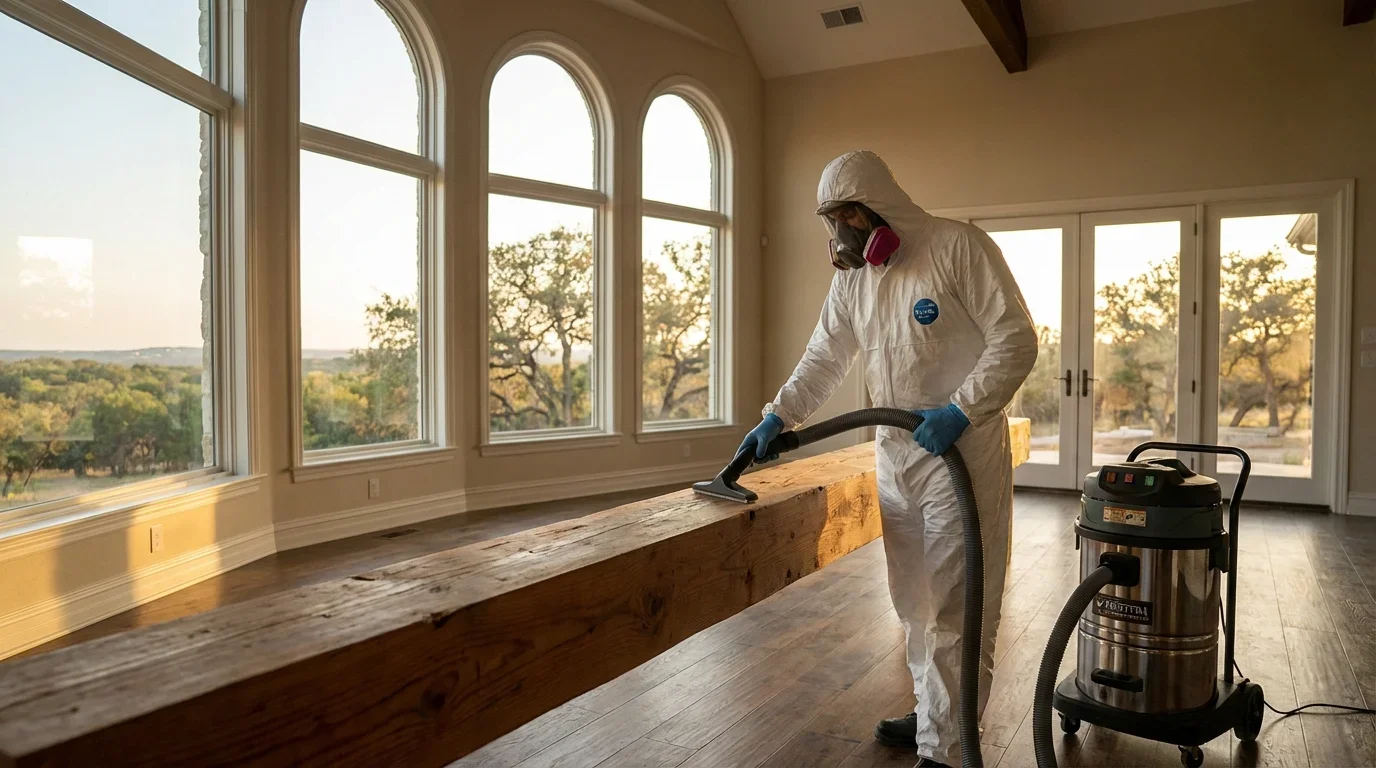
Mold Doesn't Clock Out When Your Business Does
Commercial mold spreads fast—threatening employee health, shutting down operations, and opening you up to liability. Every day you wait costs more.
- Stop mold before it stops your business
- Protect employees, customers, and your reputation
- Minimize downtime with rapid commercial response
⚠ Common Issues
When Commercial Properties Need Mold Remediation
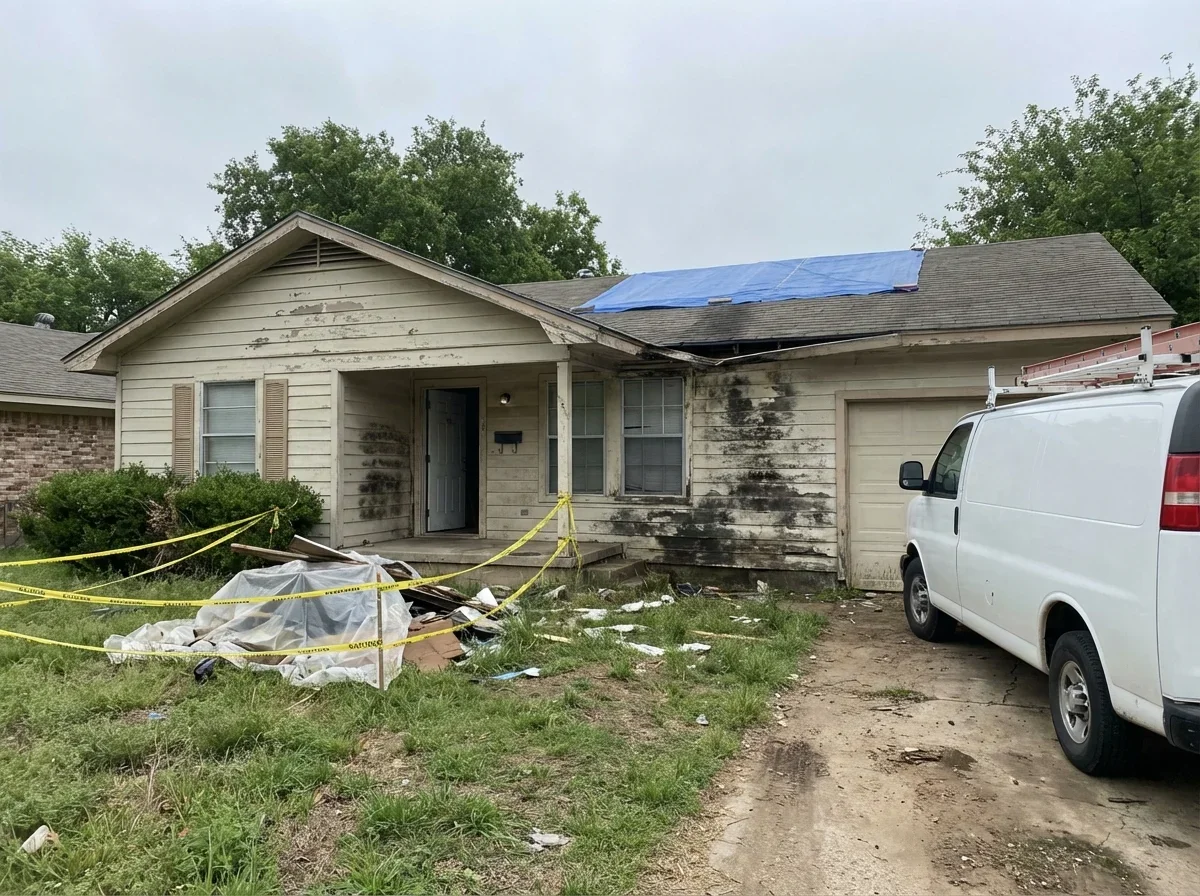
You manage a business, not a science lab. But when tenants complain about musty odors in the break room, or you spot ceiling stains after Houston's latest flooding event, the decision timeline compresses fast.
Commercial mold grows differently than residential cases. High-occupancy buildings in Dallas or Austin circulate contaminated air through HVAC systems building-wide. Restaurant kitchens in San Antonio generate constant steam and grease condensation. Warehouses in Corpus Christi develop hidden growth behind stacked inventory after roof leaks go unnoticed for months.
Texas law kicks in at 25 contiguous square feet of mold growth — requiring licensed assessment and remediation under TDLR regulations.[1] Most commercial discoveries exceed this threshold immediately. An office HVAC plenum with visible mold affects every tenant floor. A retail space water intrusion event saturates drywall across multiple units.
The operational risks escalate beyond property damage. Employees file OSHA complaints. Lease agreements trigger habitability clauses. Insurance carriers demand certified clearance before coverage continues.
Business continuity depends on speed and documentation. A Fort Worth office building can lose $15,000-$25,000 per day in lost productivity during full remediation — phased approaches cut this by 60-70%.
You need contractors who understand commercial scheduling constraints, regulatory compliance documentation, and building systems — not just residential mold cleanup crews scaling up.
$ Cost Guide
What Does Commercial Mold Remediation Cost in Texas?
Commercial pricing reflects project scale, containment complexity, and business continuity requirements — not simple square footage calculations.
Cost Factors by Building Type and Square Footage
| Building Type | Typical Cost Range | Key Variables |
|---|---|---|
| Small office suite (1,000-2,500 sf) | $3,500 - $12,000 | HVAC involvement, after-hours premium |
| Multi-tenant building (5,000-15,000 sf) | $15,000 - $45,000 | Phased scheduling, containment zones |
| Restaurant/commercial kitchen | $8,000 - $25,000 | Grease buildup, health dept coordination |
| Warehouse/industrial (20,000+ sf) | $25,000 - $150,000+ | Height access, inventory protection |
| School/institutional | $20,000 - $80,000 | Student safety protocols, summer scheduling |
Square footage alone doesn't determine cost. A 2,000-square-foot office with extensive HVAC contamination costs more than a 10,000-square-foot warehouse with localized roof leak damage. Containment complexity, accessibility, and building systems involvement drive pricing.
Insurance Claims and Business Interruption Costs
Commercial policies typically cover sudden water intrusion events (burst pipes, storm damage) but exclude long-term maintenance failures. Your adjuster requires:
- Licensed assessment report documenting pre-loss conditions
- Remediation Protocol meeting TDLR standards
- Post-remediation clearance certificate from independent assessor
- Detailed scope of work with itemized costs
Business interruption coverage — if included in your policy — requires documentation of revenue loss during remediation. Contractors who offer phased scheduling and after-hours work reduce these claims significantly. A Plano office building remediation scheduled for nights/weekends eliminates interruption costs entirely versus full closure.
Material costs: removal and disposal ($2-$8 per square foot), reconstruction ($15-$45 per square foot depending on finishes), HVAC system cleaning ($1,500-$8,000 per air handler).
After-hours premium adds 15-25% to labor costs but protects operational revenue. Most commercial clients in Houston and Dallas choose this approach for tenant-occupied buildings.
For documentation requirements similar to residential transactions, insurance claim mold services cover the compliance paperwork and adjuster coordination.
→ What to Expect
The Commercial Mold Remediation Process
Commercial projects follow a structured protocol designed to minimize disruption while meeting Texas regulatory standards.
Initial Assessment and Containment Planning
A licensed Mold Assessment Consultant conducts building-wide inspection — HVAC systems, concealed spaces, moisture mapping with thermal imaging. They identify the contamination extent, moisture sources (roof leaks, plumbing failures, condensation patterns), and affected building systems.
The assessment produces a detailed Remediation Protocol required under TAC 78.500 for projects over 25 square feet.[2] This document specifies containment zones, removal methods, air filtration requirements, and clearance criteria. For occupied buildings, the protocol addresses OSHA worker protection standards and tenant notification procedures.[3]
Remediation Execution and Air Quality Clearance
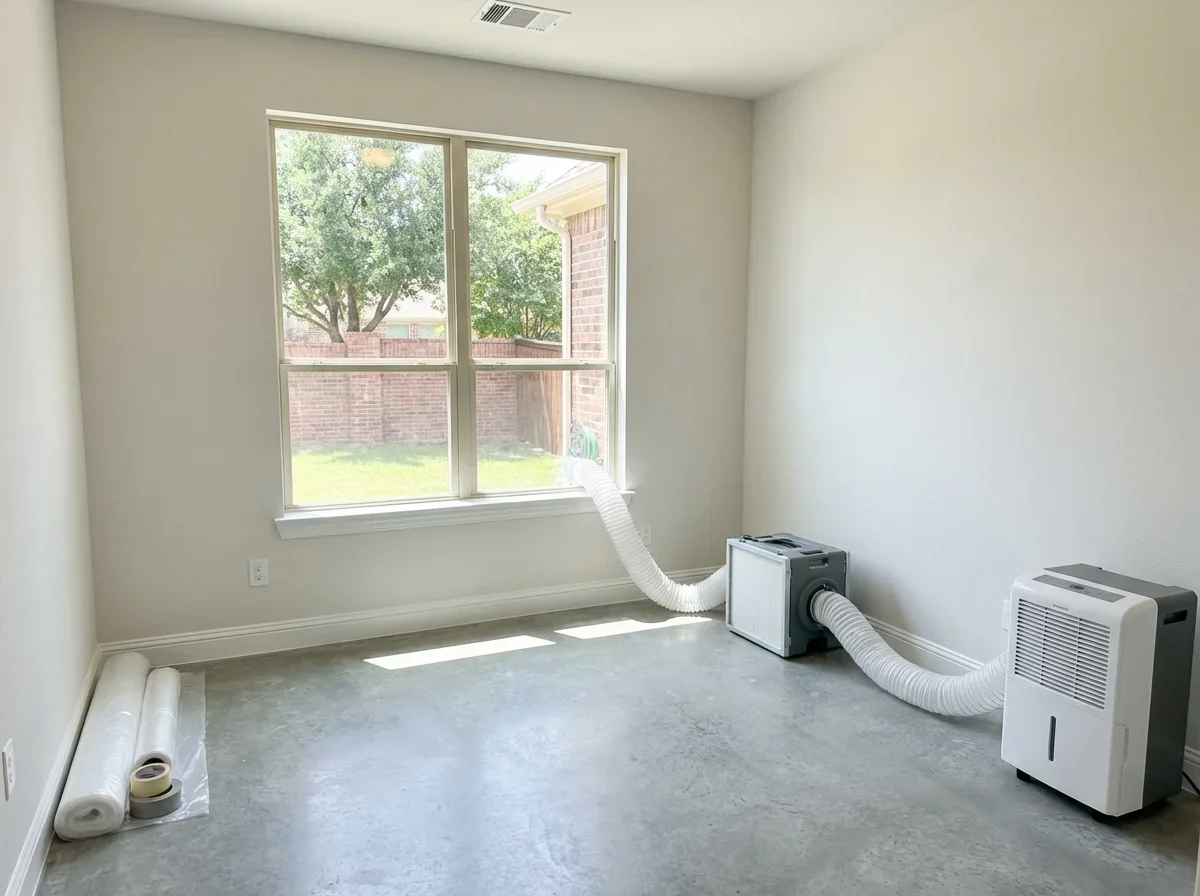
Licensed remediation teams establish containment zones with negative air pressure and HEPA filtration. Work typically occurs after-hours or in phased sections to maintain business operations.
The process:
- Containment installation — physical barriers, negative air machines, decontamination chambers
- Material removal — contaminated drywall, insulation, ceiling tiles, ductwork
- HVAC cleaning — coil treatment, duct cleaning, filter replacement (critical for HVAC mold removal)
- HEPA vacuuming and antimicrobial application — surfaces and structural cavities
- Post-remediation verification — independent air quality testing by separate licensed assessor
Texas requires post-remediation clearance testing by a different company than the remediator — preventing conflict of interest. Air samples must meet spore count baselines before reoccupancy approval.
Timeline varies by scope: small office suites (3-5 days), multi-tenant buildings (2-4 weeks phased), industrial facilities (4-8 weeks with operational coordination).
✓ Choosing a Contractor
How to Choose a Commercial Mold Remediation Contractor in Texas
Commercial projects demand capabilities beyond residential experience. Your contractor selection directly impacts regulatory compliance, insurance outcomes, and business continuity.
TDLR Licensing and Insurance Requirements
Questions to ask:
- Is your company licensed as a Mold Remediation Company with TDLR? (Verify at tdlr.texas.gov — license number should appear on proposals)
- Do individual technicians hold Mold Remediation Worker licenses?
- What liability insurance limits do you carry for commercial projects? (Minimum $1 million general liability; $2 million for large buildings)
- Do you use a separate licensed assessor for post-remediation clearance testing? (Required by Texas law to avoid conflict of interest)
- Can you provide clearance certificates acceptable to commercial insurance carriers?
Industry Certifications and Commercial Experience
Look for IICRC (Institute of Inspection Cleaning and Restoration Certification) credentials in Applied Microbial Remediation and Commercial Drying. These indicate training in large-scale containment and building systems knowledge.
Ask for commercial references — specifically projects similar to your building type. An office remediation specialist may lack warehouse height access equipment. A restaurant specialist understands health department notification requirements.
Business Continuity Planning and Scheduling
Red flags:
- Inability to provide detailed phased scheduling options
- No experience with occupied building containment protocols
- Generic residential-style proposals without OSHA compliance language
- Reluctance to coordinate with facility management or IT infrastructure teams
Green flags:
- Offers after-hours and weekend scheduling to minimize disruption
- Provides detailed project timeline with tenant communication templates
- Coordinates with building engineers on HVAC shutdown/restart procedures
- Includes clearance testing timeline in project schedule
The contractors listed in our directory hold active TDLR licenses and carry commercial insurance appropriate for multi-tenant and institutional projects. Compare their commercial portfolios, phased scheduling capabilities, and post-remediation documentation processes before selecting your remediation partner.
Top Contractors for Commercial Mold Remediation
View all →


Frequently Asked Questions
- Texas Department of Licensing and Regulation (TDLR). "Mold Abatement and Remediation." https://www.tdlr.texas.gov/mold/mold.htm. Accessed April 02, 2026.
- Texas Secretary of State. "Texas Mold Assessment and Remediation Rules (TAC 78.100 - 78.500)." https://texreg.sos.state.tx.us/public/readtac%24ext.TacPage?sl=T&app=9&p_dir=P&p_rloc=145454&p_ploc=1&pg=1&p_tac=&ti=22&pt=1&ch=78&rl=500. Accessed April 02, 2026.
- Occupational Safety and Health Administration (OSHA). "Guidelines on Assessment and Remediation of Fungi in Indoor Environments." https://www.osha.gov/publications/fungi.html. Accessed April 02, 2026.