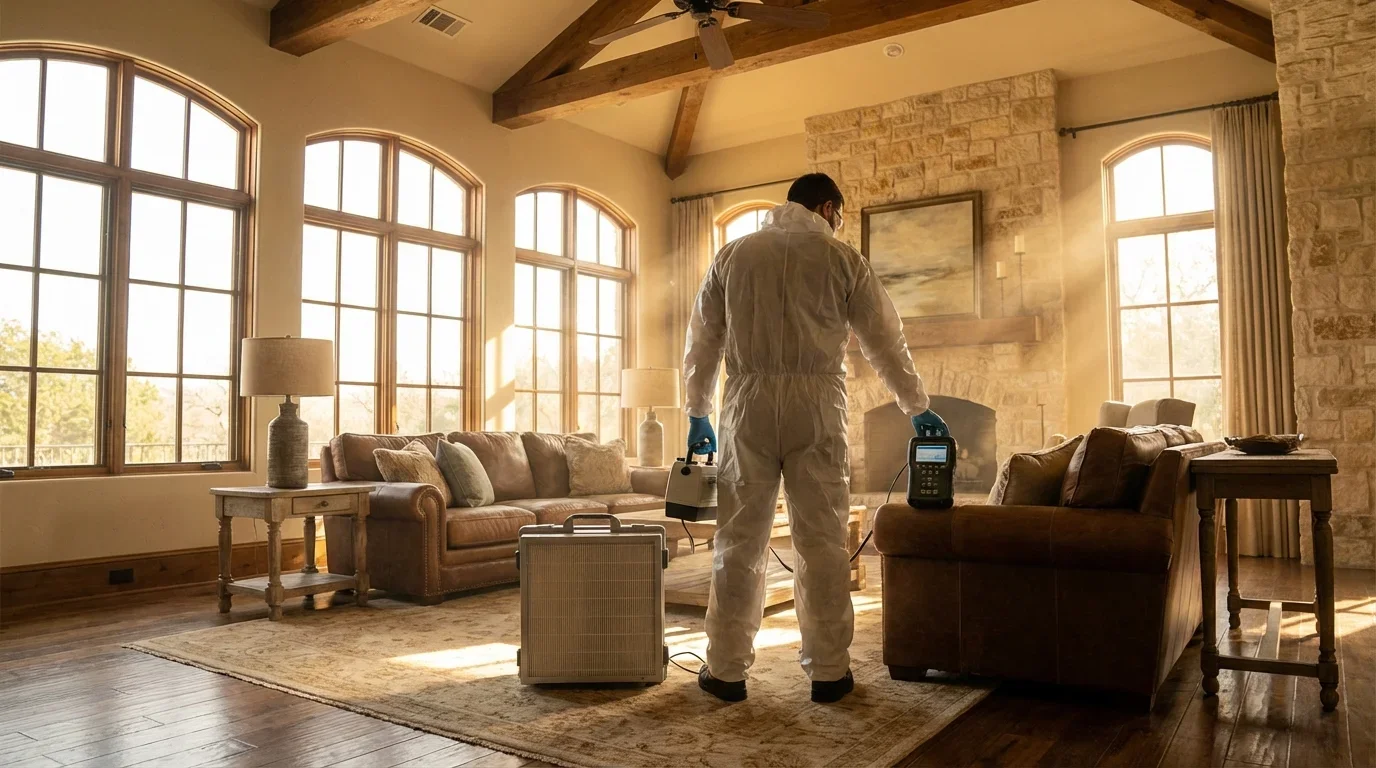
Breathe Easy — Know What's Really in Your Air
You can't see mold spores, VOCs, or allergens, but your family breathes them daily. Our comprehensive testing reveals exactly what's circulating through your Texas home.
- Precise measurement of invisible threats
- Lab-certified mold and allergen analysis
- Clear answers about your indoor air
⚠ Common Issues
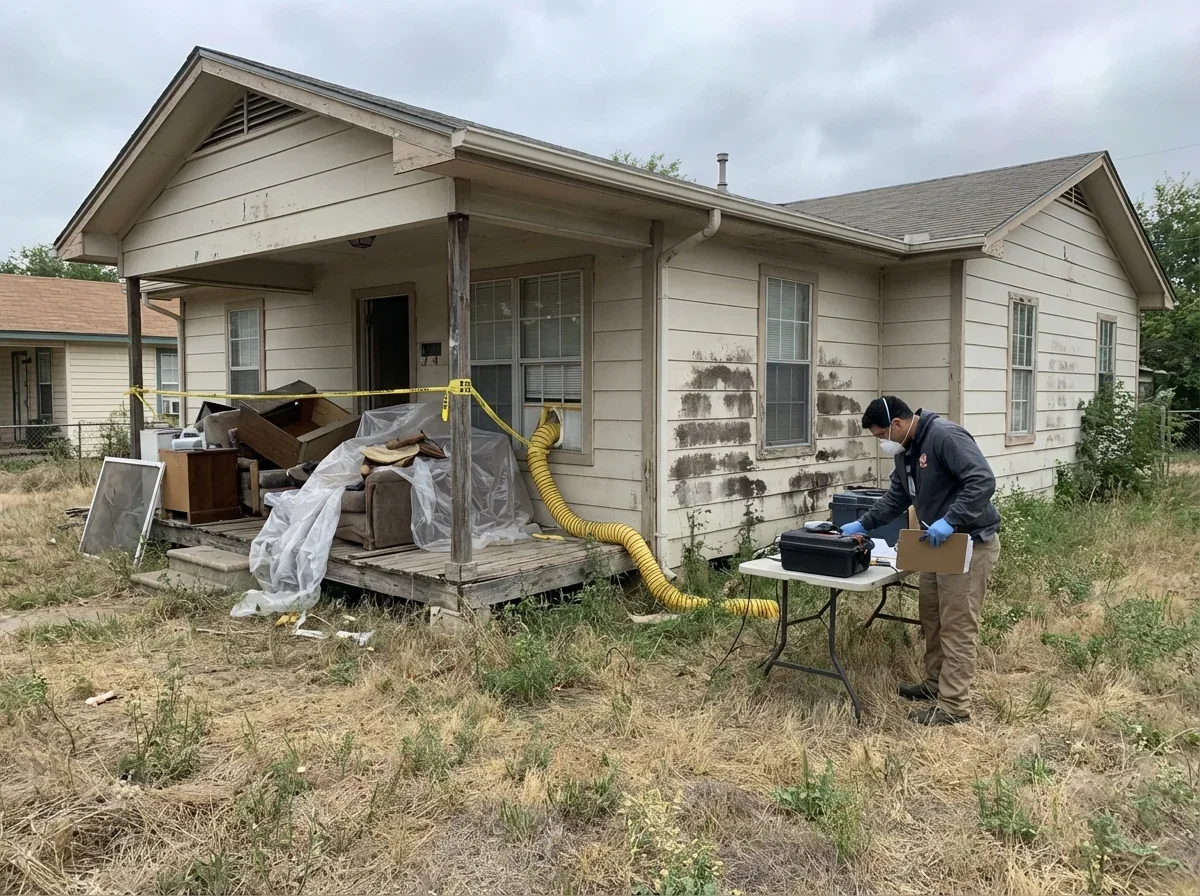
When Do You Need Air Quality Testing?
You don't test air quality on a hunch alone. Specific situations demand verification — especially in Texas, where Gulf Coast humidity sustains mold growth and proximity to industrial areas introduces airborne VOCs.[2]
Post-remediation clearance testing is non-negotiable. If you've just completed mold remediation or water damage mold removal, insurance carriers and TDLR regulations require independent air sampling to confirm spore counts returned to normal.[1] Without clearance documentation, your claim may not close.
Unexplained respiratory symptoms point to invisible triggers. Persistent coughing, sinus congestion, or aggravated asthma — especially if symptoms improve away from the property — warrant professional testing.
Real estate transactions in Houston and Dallas increasingly include IAQ assessments during inspections. Buyers want baseline data before closing. Commercial property managers in San Antonio and Austin schedule annual testing to meet lease requirements and verify HVAC system performance.
Sustained indoor humidity above 60% — common along the Gulf Coast from May through September — creates conditions where mold spores proliferate invisibly behind walls and in HVAC ducts.[3] Testing reveals what you can't see during a visual mold inspection.
Post-hurricane flooding, freeze event pipe bursts, or extended roof leaks justify testing even after visible damage is repaired. Elevated spore counts persist long after surfaces dry.
$ Cost Guide
What Does Indoor Air Quality Testing Cost in Texas?
Lead with real numbers. Residential IAQ testing in Texas averages $300-$800 depending on property size and contaminant scope.
Residential vs Commercial Pricing
| Property Type | Scope | Typical Cost |
|---|---|---|
| Single-family home (1-2 samples) | Mold spore analysis only | $300-$450 |
| Residential (3-5 samples) | Mold + outdoor control | $500-$800 |
| Commercial property (<5,000 sq ft) | Multi-zone sampling | $800-$1,500 |
| Large commercial/industrial | Comprehensive panel (mold, VOCs, particulates) | $1,500-$3,000+ |
Post-remediation clearance testing costs less when bundled with the original remediation contract — many contractors include it in final pricing. Standalone clearance runs $350-$600 for residential properties.
What's Included in a Standard IAQ Test
Base pricing covers:
- On-site assessment and sample collection (1-2 hours)
- AIHA-accredited laboratory analysis
- Outdoor control sample for comparison
- Written report with spore counts and interpretation
- Follow-up consultation to review findings
VOC testing adds $200-$400 to base pricing. Allergen-specific testing (pollen, dust mites, pet dander) runs an additional $150-$300 per allergen panel.
Cost Factors That Increase Pricing
Square footage drives sample quantity. A 1,200 sq ft home in El Paso needs 2-3 samples. A 4,000 sq ft property in Arlington requires 5-7 zones for accurate assessment.
Accessibility affects labor costs. Attic or crawl space sampling adds $100-$200 per difficult location.
Rush analysis (same-day or next-day results) carries premium fees of $150-$300. Standard 48-hour turnaround meets most needs unless you're closing a real estate transaction on a tight deadline.
Insurance coverage varies. Many policies cover testing after documented water damage or as part of insurance claim mold services. Check your policy — you may only pay the deductible.
→ What to Expect
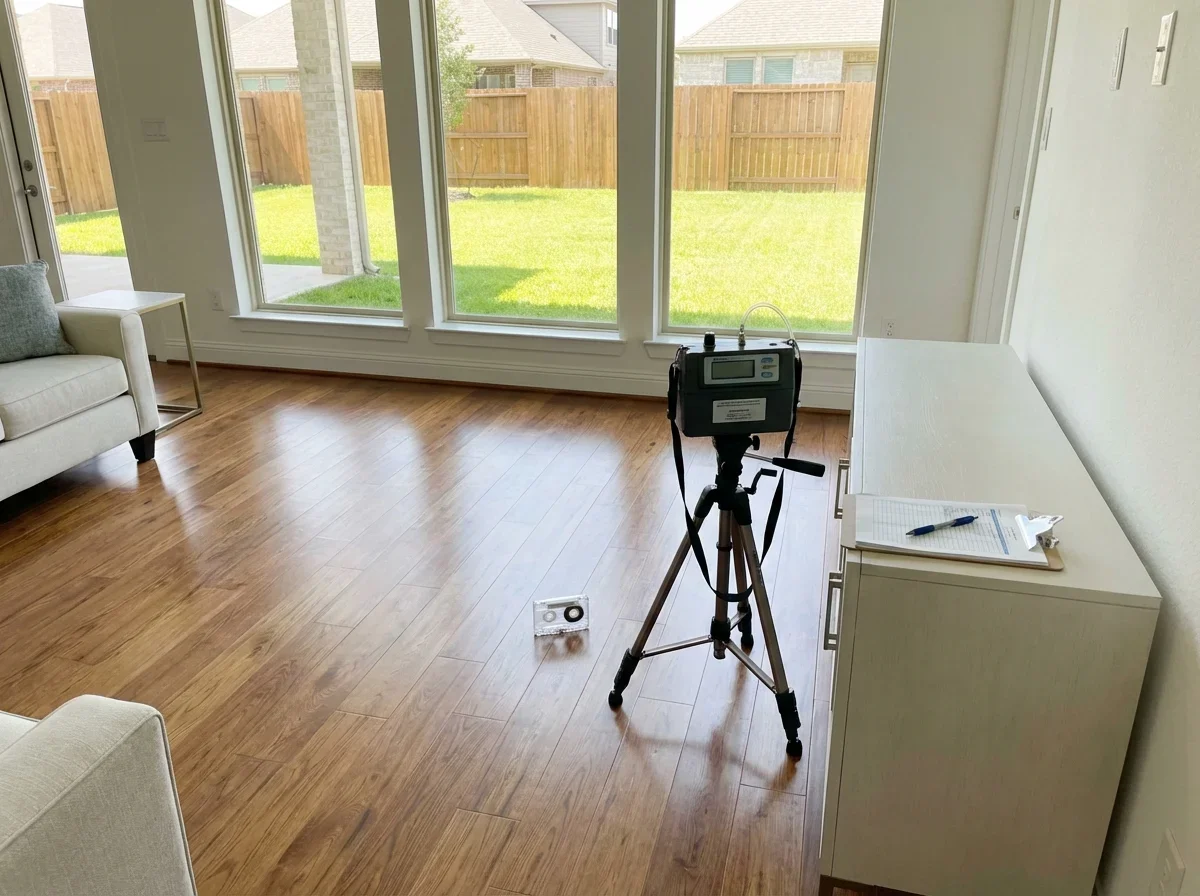
The Air Quality Testing Process
Professional IAQ testing follows a structured protocol — not a quick walk-through with a handheld device.
Pre-Test Consultation and Baseline Conditions
The assessor documents current conditions before sampling: HVAC operation status, recent weather events, visible water damage, occupant health complaints. They establish a testing plan based on square footage, suspected contaminants, and regional factors. In Fort Worth or Plano, that might include VOC screening if you're near industrial zones. Along the coast in Corpus Christi, mold spore analysis takes priority after tropical storm exposure.
Baseline outdoor samples are collected for comparison — you need to know what spore levels exist naturally in Texas air versus what's amplifying indoors.
Sample Collection Methods
Air sampling methods vary by contaminant type:
| Method | What It Measures | Turnaround Time |
|---|---|---|
| Spore trap (non-viable) | Total mold spore count and types | 24-48 hours |
| Culturable sampling | Living mold colonies | 5-7 days |
| VOC canister sampling | Volatile organic compounds | 7-10 days |
| Particle counter | Real-time particulate matter | Immediate |
Most residential tests use spore trap cassettes — calibrated air pumps draw a measured volume through collection media. The lab identifies spore types under microscopy and quantifies concentrations per cubic meter.[3]
Laboratory Analysis and Report Delivery
AIHA-accredited labs (American Industrial Hygiene Association) process Texas samples with chain-of-custody documentation. Your report shows:
- Spore counts for each sample location (bedroom, living area, attic, outdoor control)
- Genus-level identification (Aspergillus, Penicillium, Stachybotrys, etc.)
- Comparison to outdoor baseline and industry reference ranges
- Interpretation notes on elevated counts or unusual species
Typical turnaround: 24-48 hours for mold analysis, 7-10 days for comprehensive VOC panels. The TDLR-licensed assessor reviews results with you and recommends next steps — clearance achieved, further investigation needed, or post-remediation verification required.
✓ Choosing a Contractor
How to Choose an Air Quality Testing Professional
Credentials separate qualified assessors from equipment operators. Texas regulations are clear: mold-related air sampling requires a TDLR mold assessment license.[1]
Questions to Ask
- "What is your TDLR mold assessment license number?" — Verify active status at tdlr.texas.gov before hiring
- "Which lab processes your samples, and are they AIHA-accredited?" — AIHA accreditation ensures quality control and defensible results
- "Do you provide outdoor control samples?" — Without baseline outdoor data, indoor counts lack context
- "What certifications do your technicians hold?" — Look for MICRO (Microbial Investigation Certification), ACAC (American Council for Accredited Certification), or IAQA credentials
- "How many samples will you collect, and why?" — Cookie-cutter "two samples everywhere" approaches miss contamination; sampling plans should match property layout and suspected issues
- "What's the turnaround time, and what happens if results show elevated levels?" — Qualified assessors interpret results and recommend next steps, not just deliver numbers
Red Flags
- Offering testing without a valid TDLR mold assessment license in Texas
- Pressure to buy remediation services from the same company conducting testing (conflict of interest — assessors and remediators must be separate entities under TDLR rules)
- Unusually low pricing under $250 for residential testing (legitimate lab analysis and licensing carry overhead costs)
- No written report or refusal to share lab documentation
Texas Licensing and Lab Standards
TDLR requires mold assessors to complete 40 hours of approved training and pass a state exam. Renewals occur every two years with continuing education requirements. This regulatory framework protects homeowners from unqualified samplers making unsubstantiated claims.
AIHA-accredited labs follow strict protocols for sample handling, analysis methods, and reporting standards. Chain-of-custody documentation tracks your samples from collection through analysis — critical if results become part of legal proceedings or insurance disputes.
When comparing providers in our directory, prioritize TDLR license verification first, then review certifications and lab partnerships. A qualified assessor coordinates testing independently from remediation — protecting your interests with unbiased data.
Top Contractors for Indoor Air Quality Testing
View all →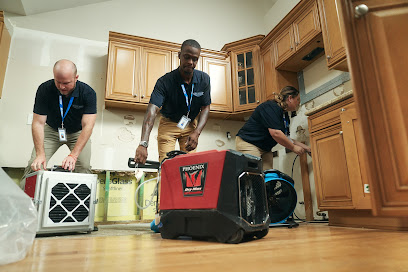

Frequently Asked Questions
- Texas Department of Licensing and Regulation (TDLR). "Mold-Related Services Licensing Program." https://www.tdlr.texas.gov/mold/mold.htm. Accessed April 02, 2026.
- Texas Commission on Environmental Quality (TCEQ). "Indoor Air Quality." https://www.tceq.texas.gov/airquality/indoorair. Accessed April 02, 2026.
- Texas A&M AgriLife Extension Service. "Guidelines for Environmentally Healthy Homes: Indoor Air Quality." https://agrilifeextension.tamu.edu/library/air-quality/indoor-air-quality/. Accessed April 02, 2026.