How Mold Gets Inside Your Air Ducts
Mold needs three things to grow: moisture, organic material, and warm temperatures. Your ductwork offers all three.
Condensation forms when cold air from your AC meets warm, humid air inside the ducts — especially in unconditioned attic spaces where Texas summer temperatures regularly hit 140°F. That moisture settles on dust, skin cells, and fibers that accumulate inside ducts over time. Mold spores, which are always present in outdoor air, enter through gaps in duct seams, return vents, and the HVAC intake. Once they land on a moist surface, they colonize within 24 to 48 hours.
Plumbing leaks under slab foundations — the most common structural problem in Texas homes built on expansive clay soil — create hidden moisture intrusion that affects nearby ductwork. In Houston, Dallas-Fort Worth, and San Antonio, foundation shifting from wet-dry soil cycles causes slab cracks and slow pipe leaks that go undetected for months. By the time you notice a musty smell from the vents, the leak has been feeding mold growth in both the duct insulation and surrounding building cavities.
Post-2000 construction in Austin and North Texas often features spray foam insulation and complex two-story HVAC systems. While spray foam improves energy efficiency, poorly sealed duct connections in attics or wall cavities trap condensation. Tract homes built rapidly during the 2010s housing boom sometimes have moisture management defects — missing vapor barriers, improper flashing around roof penetrations, or undersized AC drain pans that overflow during heavy cooling loads.
Older pier-and-beam homes in established neighborhoods across Texas metros have different risks. Crawl space humidity seeps into floor-level return ducts, and fiberglass duct insulation in unconditioned spaces absorbs moisture directly from the air. If your home was built before 1980, your ductwork may have original insulation that's degraded over decades of exposure to temperature swings and occasional roof leaks.
Visible Warning Signs in and Around Vents
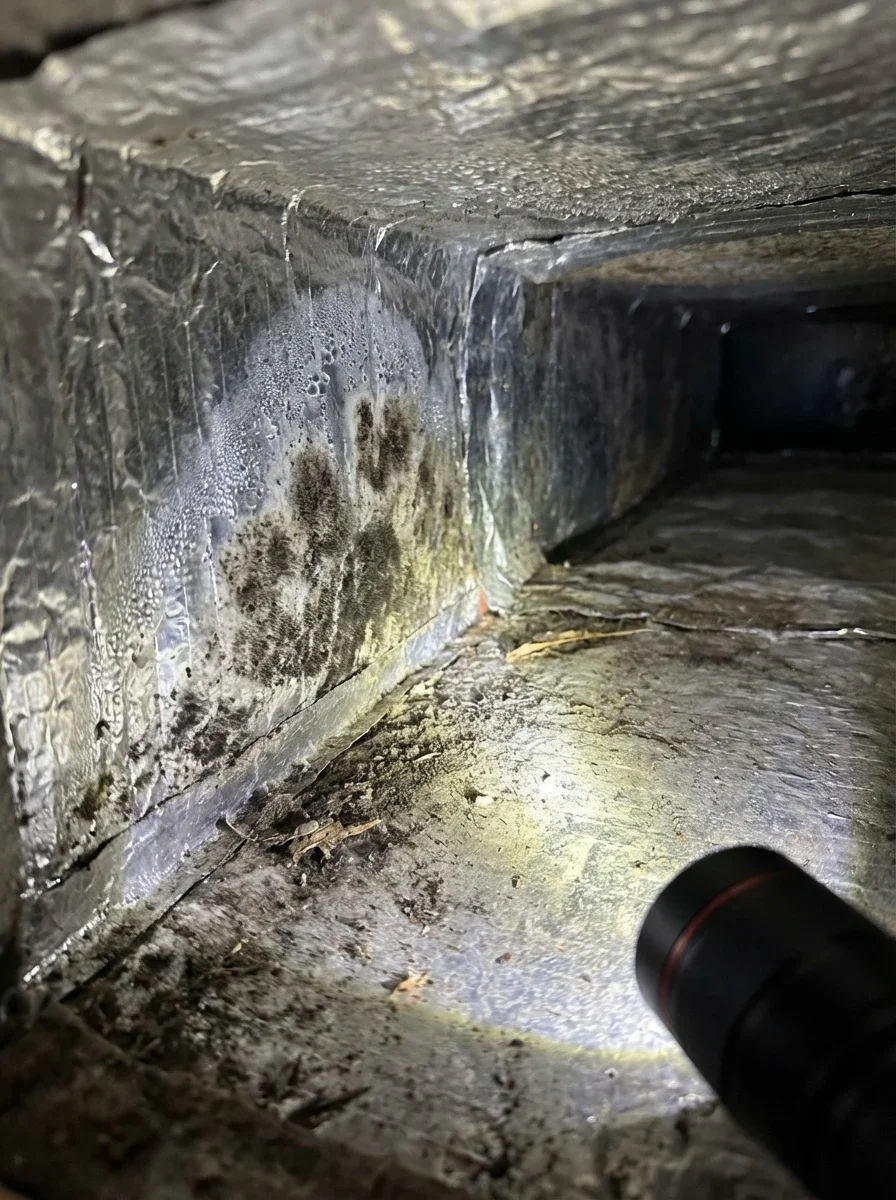
You don't always need an inspection to know there's a problem. Mold inside air ducts leaves clues you can spot from the ground floor.
Check your supply and return vents for dark spots, streaks, or fuzzy patches around the grille edges. Mold often appears as black, gray, green, or even white discoloration on metal vent covers or the visible portion of ductwork behind the grille. If you remove a vent cover and see staining on the duct interior or insulation, that's direct evidence of microbial growth.
Condensation rings or water stains around vents indicate ongoing moisture problems. You might notice dampness on the ceiling or wall near supply registers, especially in bathrooms, kitchens, or rooms above unconditioned attics. In Texas homes with spray foam insulation, condensation sometimes collects at the point where ducts penetrate the envelope — look for discoloration or soft drywall around those transitions.
Dust that looks darker or greasier than normal accumulates around vents when mold spores mix with airborne particles. If you wipe a vent cover and the residue is black or smells earthy, it's worth investigating further. Some homeowners describe a "slimy" texture on register louvers after running the AC continuously during summer.
Warped or sagging ductwork visible in attics or crawl spaces can signal water intrusion.
Fiberglass duct board that appears compressed, discolored, or delaminated has likely been wet. Flexible ducts that sag between support points create low spots where condensation pools — these become mold hotspots.
Quick Reference: Visual Mold Warning Signs
- Dark spots, streaks, or fuzzy patches on vent grilles and covers
- Condensation rings or water stains around supply registers
- Darker, greasier dust accumulation with earthy smell
- Slimy texture on register louvers after extended AC use
- Warped, sagging, or discolored ductwork in attics/crawl spaces
- Compressed or delaminated fiberglass duct insulation
Smells That Point to Duct Mold
The musty, earthy odor of mold is often the first warning sign homeowners notice. It gets stronger when the AC kicks on because air circulation releases volatile organic compounds (VOCs) produced by active mold colonies.
If the smell is only noticeable in certain rooms, the mold may be localized to duct sections serving those areas. A musty odor that spreads throughout the house when the system runs suggests contamination in the main trunk line or air handler. The smell usually intensifies after the AC has been off for several hours — mold growth accelerates in still, humid air, then gets distributed when the system restarts.
Some people describe the smell as "dirty socks" or "wet basement," even in homes without basements.
That's often Stachybotrys or Aspergillus species colonizing on organic dust inside ducts. The odor can be faint at first but becomes more pronounced as colonies expand. If you've recently had ductwork sealed or modified and notice a new smell, disturbed mold may be circulating through registers.
AC drain pan overflow creates a distinct sewer-like odor when mold grows in standing water mixed with algae and bacteria. If the smell is concentrated near the air handler or you hear dripping sounds, check the condensate drain line for clogs. In Texas, where AC systems run year-round, drain pans in attics can overflow unnoticed until mold spreads to surrounding insulation and ductwork.
Health Symptoms Linked to Airborne Mold Exposure
Mold spores circulating through your HVAC system affect indoor air quality in every room. Symptoms vary based on individual sensitivity, but respiratory issues are the most common complaint.
Persistent coughing, throat irritation, and nasal congestion that worsens when you're home — but improves when you leave — are telltale signs of indoor mold exposure. Some people develop sinus infections that don't respond to typical treatments, or experience wheezing and chest tightness even without a history of asthma. Children and elderly family members often show symptoms first because their immune systems are more vulnerable.
Headaches, fatigue, and difficulty concentrating can stem from prolonged exposure to mycotoxins produced by certain mold species.
If multiple household members feel unusually tired or "foggy" indoors, poor air quality is a likely contributor. Eye irritation, skin rashes, and worsening seasonal allergies also correlate with mold in HVAC systems.
People with asthma or compromised immune systems face higher risks. Mold exposure can trigger asthma attacks, and immunocompromised individuals may develop serious fungal infections. The EPA notes there are currently no federal regulations or standards for airborne mold contaminants,[1] but that doesn't mean exposure is harmless — it means you're responsible for monitoring your own indoor environment.
If you've recently moved into a home and developed new respiratory symptoms, or if symptoms improve significantly when you run portable air purifiers, your HVAC system is the likely culprit. Many Texas homeowners report symptom relief within days of professional HVAC mold removal.
Increased Dust and Poor Airflow
Mold doesn't just smell bad — it interferes with your HVAC system's performance.
If you're dusting more often than usual or notice dust accumulating on surfaces within a day or two of cleaning, contaminated ducts may be the source. Mold colonies trap airborne particles, creating a layer of biological and mineral buildup inside ducts. That buildup restricts airflow, forcing your AC to work harder to maintain temperature. You might notice some rooms stay warmer than others, or the system runs longer cycles without cooling effectively.
Higher energy bills often coincide with reduced airflow from dirty or mold-contaminated ductwork.
Filter clogs happen faster when mold spores and fungal fragments circulate through the system. If you're replacing your air filter every few weeks instead of every one to three months, that's a red flag. Inspect used filters under good light — dark, irregular staining or a damp, earthy smell indicates mold contamination upstream in the ductwork.
Visible dust puffing from vents when the AC starts is another indicator. Clean ducts release minimal dust. If you see a cloud of particles every time the system cycles on, there's significant contamination inside the duct network. Some homeowners describe "gritty" or "oily" dust that's harder to clean than typical household dust — that texture comes from mold spores mixed with HVAC lubricants and condensation residue.
In Texas homes with spray foam insulation and sealed building envelopes, restricted airflow from clogged ducts can create negative pressure that pulls unconditioned attic air into living spaces. That compounds the problem by introducing more humidity, dust, and outdoor allergens.
Pro Tip: If you're replacing HVAC filters more than once a month, don't just keep buying filters — this is your system telling you there's upstream contamination. Schedule an inspection before the problem compounds into costly duct replacement or health issues.
Where Mold Hides Inside HVAC Systems
Not all mold growth is visible from a vent grille. Understanding where contamination hides helps you know when professional mold inspection is necessary.
Air handler cabinets — the metal boxes that house your blower fan and evaporator coil — are prime mold locations. Condensation drips onto the coil fins and collects in the drain pan below. If the drain line clogs or the pan rusts through, water pools in the cabinet. Insulation lining the interior walls absorbs moisture, creating an ideal surface for mold.
Many homeowners don't inspect inside the air handler until the AC stops cooling properly.
Evaporator coils themselves often develop mold because they're constantly wet during cooling cycles. A thin biofilm forms on the aluminum fins, reducing heat transfer efficiency and circulating spores into the duct system. If your AC is blowing warm air or freezing up frequently, mold buildup on the coil may be part of the problem.
Condensate drain pans and lines clog with algae, mold, and sediment.
Texas hard water (150–300+ ppm calcium depending on region) accelerates mineral buildup that traps organic debris. Once the drain is restricted, water backs up into the air handler and overflows into surrounding ductwork or ceiling cavities. San Antonio and Hill Country homes with very hard water see this issue most often.
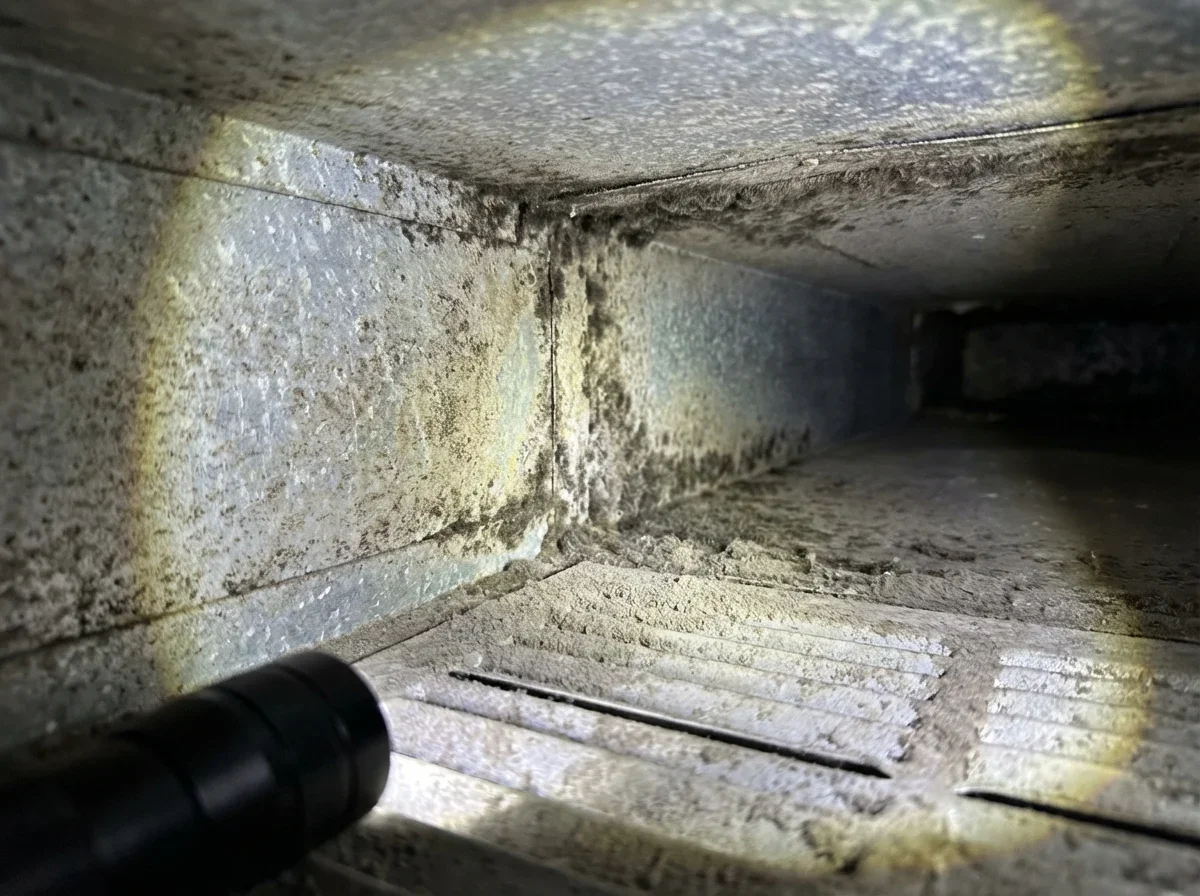
Return air plenums — the large duct boxes that pull air from your home back to the air handler — collect dust, pet dander, and skin cells. When humidity is high, that organic layer supports mold growth. Return ducts in unconditioned attics or crawl spaces are especially vulnerable because they're exposed to temperature extremes and moisture infiltration.
Flexible duct interiors are lined with fiberglass or polymer that can degrade over time. If the duct develops tears or separates at joints, moisture enters and saturates the lining. Sagging flex duct creates low points where condensation pools. Unlike metal ductwork, the porous lining can't be effectively cleaned once contaminated — it usually requires replacement.
Duct insulation in pier-and-beam homes or older construction often contains fiberglass that absorbs moisture from crawl space humidity or roof leaks.
Once wet, it stays damp for weeks and becomes a mold reservoir. Fiberglass duct board used in many 1980s–2000s Texas homes is particularly problematic because the entire duct wall is porous.
What to Do If You Suspect Mold in Your Ducts
Don't ignore the warning signs. Acting quickly limits the spread and reduces health risks.
Turn off your HVAC system if you see visible mold growth inside ductwork or the air handler. The EPA recommends stopping ventilation in contaminated systems to prevent spore distribution.[2] Running the AC with active mold colonies circulates contamination throughout your home and can worsen respiratory symptoms. If you're in the middle of a Texas summer heat wave and can't safely turn off cooling, close vents in rooms with visible mold and run portable air purifiers with HEPA filters.
Schedule a professional mold inspection with a company licensed by the Texas Department of Licensing and Regulation (TDLR). Texas requires separate licenses for mold assessment and mold remediation under the Texas Mold Assessment and Remediation Rules (TMARR). The assessor will inspect visible ductwork, take air or surface samples, and use moisture meters to identify hidden water intrusion.
You can verify credentials at tdlr.texas.gov/mol/mol.htm.
Don't attempt to clean mold inside ductwork yourself. Scrubbing releases massive spore clouds into your home, and DIY methods can't address contamination in hard-to-reach sections like vertical risers or duct boots inside wall cavities. Porous materials like fiberglass duct insulation can't be cleaned — they must be removed and replaced. The EPA's remediation guidelines specify that contaminated porous materials in HVAC systems should be bagged and discarded.[2]
If you've recently had water damage from plumbing leaks, roof leaks, or storm flooding, air quality testing can quantify spore levels before and after remediation. This creates a baseline and verifies that cleanup was successful. Many Texas homeowners who experienced mold after Hurricane Harvey or the 2025 Houston flooding say they wish they'd tested sooner instead of waiting for symptoms to worsen.
Professional Remediation for HVAC Mold
Effective remediation addresses both the mold and the moisture source.
If you only clean visible contamination without fixing the underlying water intrusion, mold returns within weeks. TDLR-licensed remediation companies start by isolating the contaminated HVAC system using negative air pressure and physical barriers. This prevents spores from spreading to unaffected areas during cleaning. Technicians remove and bag contaminated duct insulation, then HEPA-vacuum cleanable metal surfaces.
The EPA protocol calls for cleaning non-porous materials with a HEPA vacuum or moist cloth and detergent solution, followed by prompt drying.[2]
Evaporator coils are treated with EPA-registered antimicrobial solutions designed for HVAC systems. Drain pans and condensate lines are cleared, disinfected, and tested for proper drainage. If ductwork has been compromised by water damage or shows widespread contamination, sections may need replacement rather than cleaning. Flexible ducts with moldy insulation almost always require replacement because the porous lining can't be salvaged.
In Texas homes on slab foundations, remediators often discover that duct mold is a symptom of hidden plumbing leaks beneath the concrete. Foundation movement from expansive clay soil creates stress fractures in copper or PVC pipes, leading to slow leaks that saturate the soil and wick moisture into ductwork and insulation. Fixing the duct mold without repairing the plumbing guarantees recurrence.
This is why comprehensive whole house mold remediation includes moisture intrusion testing, not just visible mold removal.
After physical remediation, the HVAC system undergoes sanitization and is sealed to prevent future contamination. Upgraded filtration — typically MERV 11 or higher — helps trap spores before they colonize. Some companies apply antimicrobial coatings to duct interiors, though effectiveness varies and these treatments don't replace moisture control.
Preventing Mold From Returning
Long-term prevention requires controlling the moisture that feeds mold growth. Even the most thorough remediation fails if you don't address the root causes.
Maintain your HVAC system on a regular schedule. Change filters every 1–3 months depending on household conditions (pets, construction dust, allergies). Inspect the condensate drain pan and line quarterly — pour a cup of water mixed with vinegar or bleach down the drain to clear biofilm buildup. Have a licensed HVAC technician check refrigerant levels, coil cleanliness, and ductwork seals annually.
Low refrigerant causes coils to freeze and drip excessively, creating moisture problems.
Control indoor humidity below 60% — ideally between 30–50%. In humid Gulf Coast areas, this often requires a whole-house dehumidifier integrated with your HVAC system. Standalone units work for smaller homes but may not keep up during Houston's summer months when outdoor humidity regularly exceeds 80%. Monitor humidity with a hygrometer in multiple rooms; basements and crawl spaces tend to stay damper than living areas.
Fix plumbing leaks immediately. In Texas homes on expansive clay soil, even small foundation shifts can crack pipes. Watch for unexplained water bill increases, damp spots on floors, or the sound of running water when all fixtures are off.
If your home was built between 1980 and 2000 and still has original copper plumbing, consider having it inspected — corrosion from Texas hard water often causes pinhole leaks in 20- to 30-year-old pipes.
Seal ductwork in unconditioned spaces. Attics in Texas reach extreme temperatures, creating condensation where cold ducts meet hot air. Mastic sealant (not duct tape, which degrades) should be applied at all seams and connections. Insulate ducts in attics to R-8 or higher to prevent surface condensation. If your home has flex duct, replace sagging sections that trap water.
Improve ventilation in moisture-prone areas. Bathrooms and kitchens generate humidity that the HVAC system pulls into return ducts. Run exhaust fans during showers and cooking, and vent them to the exterior — not into the attic, which is still common in older Texas homes.
Make sure dryer vents terminate outside and aren't leaking into wall cavities.
Address foundation drainage issues. French drains, proper grading, and gutter extensions keep water away from your home's perimeter. In Houston, Dallas, and San Antonio, poor surface drainage can saturate the soil beneath slab foundations, creating rising moisture that affects ductwork embedded in or beneath the slab. After heavy rains, check that water flows away from the foundation rather than pooling.
| Prevention Method | Best For | Maintenance Frequency | Typical Cost |
|---|---|---|---|
| HVAC filter changes | All homes | Every 1–3 months | $15–$40/filter |
| Whole-house dehumidifier | Gulf Coast/humid climates | Annual inspection | $1,200–$2,500 installed |
| Duct sealing (mastic) | Homes with attic ducts | One-time + inspection every 5 years | $500–$1,500 |
| Foundation drainage improvements | Slab homes with pooling water | Inspect after heavy rain | $2,000–$8,000 |
When to Replace Instead of Clean
Sometimes remediation isn't enough. Certain conditions require duct replacement to fully resolve mold problems.
If ductwork is constructed from fiberglass duct board, and contamination extends beyond isolated sections, replacement is usually more cost-effective than attempting to clean porous material. The EPA guidance is clear: contaminated porous materials should be removed, not cleaned.[2] Many 1980s–1990s Texas homes used fiberglass duct board for trunk lines and branches.
Once mold penetrates the material, it can't be reliably eradicated.
Flexible ducts with saturated insulation also need replacement. If the inner liner is torn, the fiberglass insulation between layers has absorbed moisture, or the duct has been submerged during flooding, cleaning won't eliminate embedded mold. Post-Harvey Houston saw thousands of homes where flex ducts in attics were compromised by roof leaks and required full replacement.
Rusted or corroded metal ductwork with structural damage should be replaced rather than patched. If seams have separated due to foundation movement or the metal has rusted through in multiple locations, the integrity of the duct system is compromised.
Mold is often a secondary issue to water intrusion that's damaged the ducts themselves.
Homes that have had repeated mold problems despite remediation may need a complete duct redesign. Undersized ducts, poor layout, or incorrect installation create chronic condensation issues. In some cases, especially in older homes with outdated HVAC systems, the cost of repeated remediation exceeds the cost of modern, properly sized ductwork with upgraded insulation and sealing.
Understanding Texas Mold Regulations and Licensing
Texas is one of the few states with specific mold licensing requirements, which affects how you should approach remediation.
The Texas Department of Licensing and Regulation (TDLR) oversees mold professionals through the Texas Mold Assessment and Remediation Rules (TMARR). Separate licenses are required for mold assessment (inspection and testing) and mold remediation (cleanup and prevention). The same company cannot perform both services on the same project — this prevents conflicts of interest where a company might exaggerate mold findings to secure remediation work.
Licensed roles include Mold Assessment Technician, Mold Assessment Company, Mold Remediation Worker, Mold Remediation Contractor, and Mold Remediation Company. Only licensed professionals can perform mold assessment or remediation for compensation in Texas.
You can verify any company's license status at tdlr.texas.gov/mol/mol.htm — enter the company name or license number to confirm active status.
Remediation projects over 25 contiguous square feet require a licensed Mold Remediation Company. Smaller jobs (under 25 square feet) don't require licensing, but choosing a licensed company ensures proper procedures and insurance coverage. TDLR licensing requires proof of general liability insurance; reputable firms also carry pollution liability and professional liability coverage.
Mold remediation itself doesn't require a building permit in Texas, but fixing the underlying cause often does.
Plumbing repairs, roof work, and significant HVAC modifications require permits in most municipalities. Houston is notable for having no zoning but still requires building permits for structural and mechanical work.
If you're filing an insurance claim for mold damage, having TDLR-licensed assessment and remediation creates documentation that carriers respect. Many policies exclude mold unless it's directly caused by a covered peril (like a burst pipe or storm damage). Pre-remediation and post-remediation verification testing by a licensed assessor provides the paper trail insurers require.
Cost Expectations for Duct Mold Remediation in Texas
Pricing varies based on the extent of contamination, ductwork accessibility, and necessary repairs.
Basic HVAC system cleaning and sanitization for a home without major contamination typically runs $500–$1,500. This includes cleaning accessible duct sections, treating the evaporator coil, clearing drain lines, and applying antimicrobial treatment.
If mold is limited to the air handler cabinet and a few registers, costs stay at the lower end.
Moderate contamination requiring partial duct removal, insulation replacement, or repair of moisture sources ranges from $2,000–$6,000. This level of work is common in Texas homes with plumbing leaks under slab foundations or older homes with degraded duct insulation. Labor costs are higher if ducts are in hard-to-reach attics or crawl spaces, which is typical in two-story suburban homes.
Extensive remediation with full duct replacement, structural drying, and major HVAC repairs can exceed $10,000–$15,000.
Post-flood scenarios, homes with widespread contamination across multiple systems, or cases requiring whole house mold remediation fall into this category. The 2025 Houston flooding event saw average remediation costs in the $8,000–$12,000 range for homes with HVAC system involvement.
Mold inspection and testing by a TDLR-licensed assessor costs $300–$700 for a typical single-family home, depending on square footage and the number of samples taken. Air quality testing adds $150–$300 per sample location. Post-remediation verification testing (required to confirm clearance) costs an additional $300–$500.
Keep in mind that fixing the moisture source — plumbing repairs, roof work, foundation drainage improvements — is separate from mold remediation costs. A slab leak repair in Texas averages $1,500–$4,000 depending on accessibility. If foundation leveling is needed to stop ongoing moisture intrusion, that can add $3,000–$10,000+ to the total project.
Some remediation companies offer financing, especially for larger projects.
Texas has no statewide consumer protection fund for mold remediation, so verify the company's insurance and license status before committing. Get written estimates from at least two TDLR-licensed firms and confirm what's included: containment, removal, cleaning, disposal, post-remediation verification, and any warranty on work performed.
- US EPA. "Are there federal regulations or standards regarding mold?." https://www.epa.gov/mold/are-there-federal-regulations-or-standards-regarding-mold. Accessed April 02, 2026.
- US EPA. "Mold Course Chapter 5." https://www.epa.gov/mold/mold-course-chapter-5. Accessed April 02, 2026.
- National Institutes of Health (NIH). "Moisture and Mold Remediation Standard Operating Procedures." https://ors.od.nih.gov/sr/dohs/Documents/moisture-and-mold-remediation-sop.pdf. Accessed April 02, 2026.