The 48-Hour Rule: Why Speed Matters in Texas
Mold doesn't wait for you to figure out your insurance claim or schedule contractors. In Texas's Gulf Coast humidity — Houston averages 75% relative humidity in summer — wet building materials can hit the critical moisture threshold for mold growth within 24 hours.
Once materials stay wet for two to three days, mold colonization is nearly guaranteed.[3]
The clock starts the moment floodwater enters your home, not when you notice the problem. A slow leak under your slab-on-grade foundation might give mold a two-week head start before you spot discoloration on baseboards. But after a flooding event, you know exactly when the timer began. Your priority in the first 48 hours is removing standing water and beginning structural drying — everything else can wait.
Texas's construction practices compound the urgency. Homes built on slab foundations (the vast majority since 1980) trap moisture between the concrete and flooring. Carpet padding becomes a sponge, OSB subflooring swells, and water wicks up drywall. Without professional-grade dehumidification and air movers, these materials stay wet for weeks in our climate.
Immediate Steps: First 24 Hours After Flooding
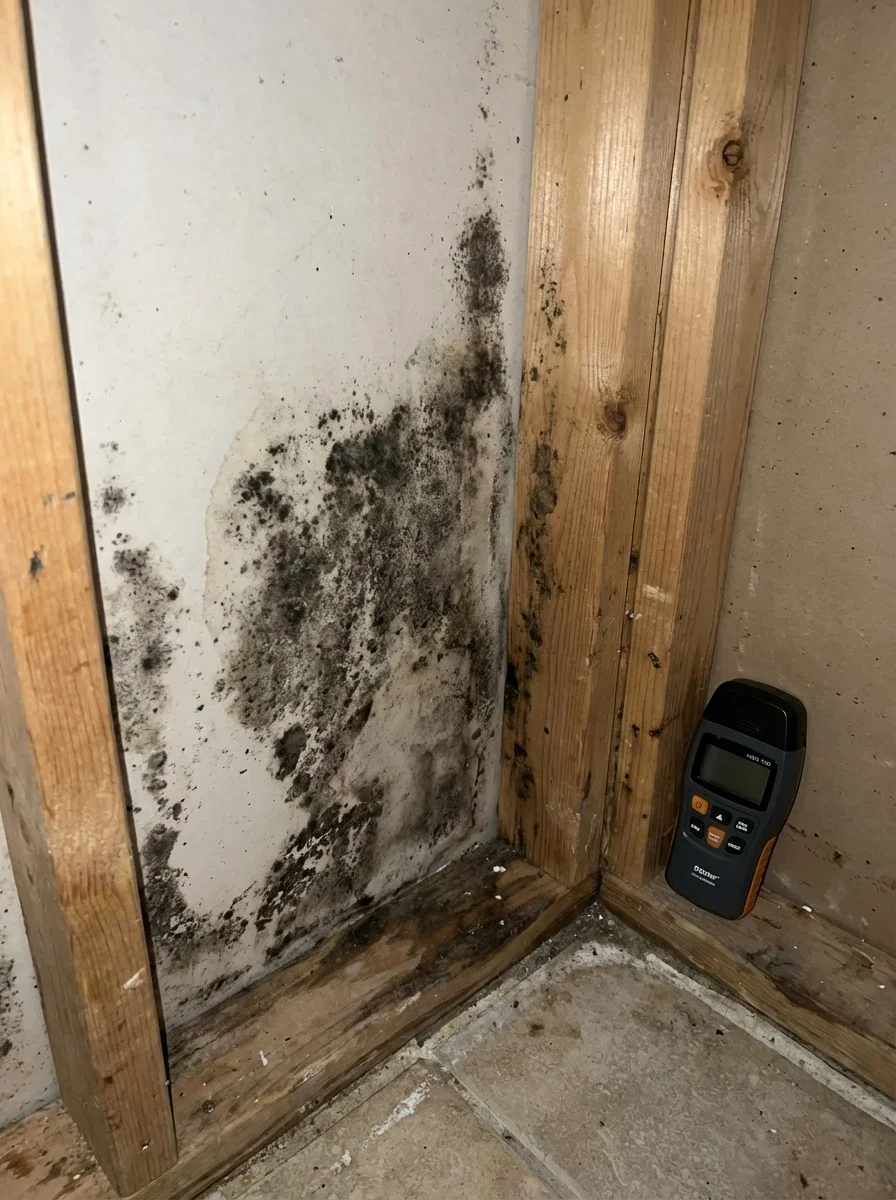
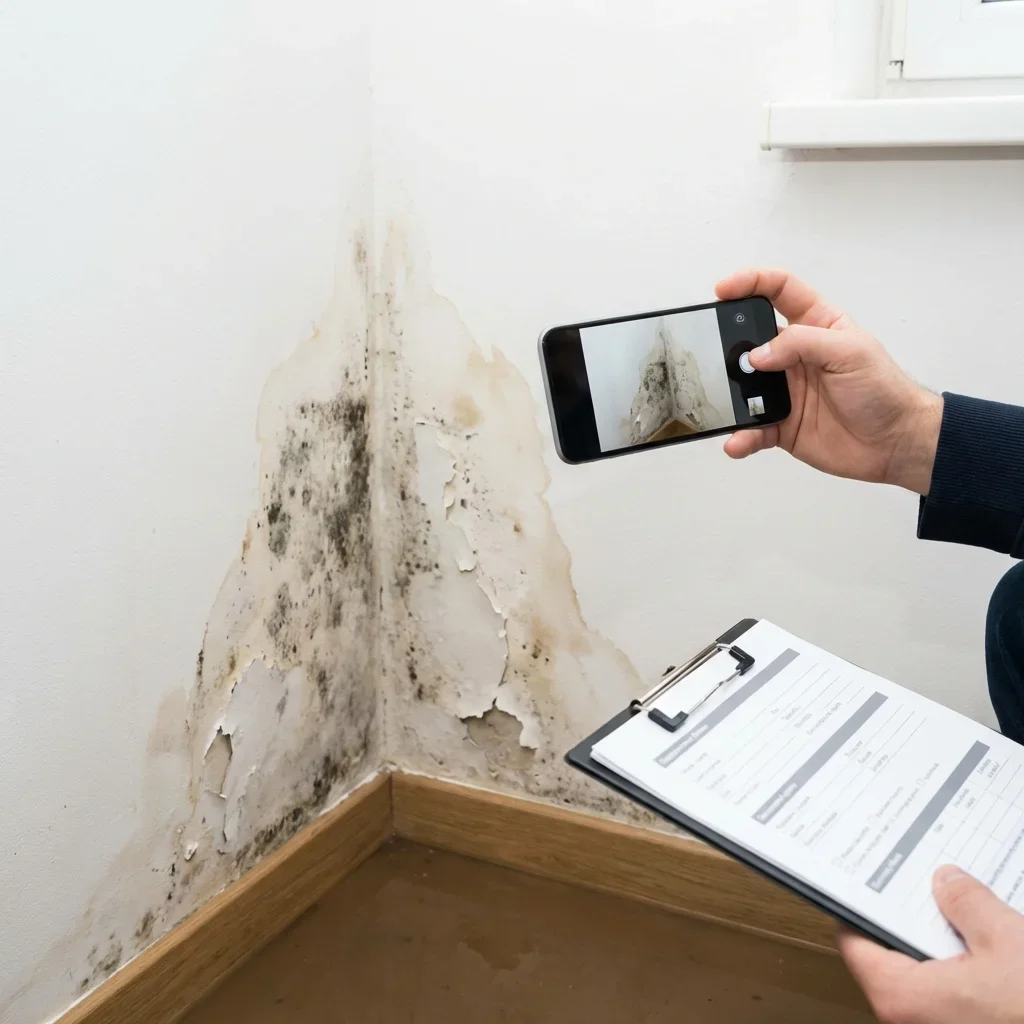
Before you touch anything, document the damage. Take photos and video of every affected room, water lines on walls, and damaged belongings — your insurance adjuster will need this, and your memory will fade.
Then shut off electricity to flooded areas at the breaker panel. Standing water plus live circuits is lethal, and you can't start remediation until power is safely restored with GFCI protection.
Remove standing water using a wet/dry vacuum, submersible pump, or professional extraction equipment. A household shop vac works for minor flooding. Anything over an inch across multiple rooms requires extraction equipment most homeowners don't own. Many Texas restoration companies offer 24-hour emergency structural drying services with truck-mounted extraction systems that pull thousands of gallons per hour.
Speed here determines everything downstream.
Start removing soaked porous materials immediately — carpet and padding are first. Once carpet backing stays wet past 48 hours, it's a mold farm. Pull it up, roll it, and get it to the curb. Furniture and belongings come next: move wet items to a garage or covered outdoor area where air can circulate. Don't pile everything in one corner of a room — you're just creating a humidity dome.
First 24 Hours Priority Checklist:
- Document all damage with photos/video before touching anything
- Shut off electricity to flooded areas at the breaker panel
- Remove standing water (shop vac for minor flooding, professional extraction for 1+ inch depth)
- Pull up wet carpet and padding within 48 hours
- Move soaked furniture and belongings to well-ventilated area
- Begin drying process immediately — every hour counts toward preventing mold
What You Can Safely Handle Yourself
If flooding is limited to one or two rooms, water was relatively clean (not sewage), and you can dry materials within 48 hours, DIY cleanup is reasonable. The EPA considers mold growth covering less than 10 square feet manageable for homeowners equipped with proper safety gear.[2]
This usually means a bathroom corner, a single wall section, or isolated areas under a kitchen sink.
Safety gear is non-negotiable. At minimum you need an N-95 respirator (not a dust mask), eye protection without ventilation holes, and waterproof gloves.[1] Long sleeves and pants protect your skin from contact with mold spores and contaminated water. Work in one small area at a time with windows open and fans exhausting air outside — never recirculating.
You can safely remove and discard non-structural porous materials: drywall, insulation, baseboards, carpet, and padding. Bag everything in 6-mil plastic contractor bags and seal them before carrying through your home. Hard surfaces like tile, sealed concrete, and metal can be cleaned with detergent and water, then thoroughly dried.
Wood framing can usually be dried in place if caught early and the source moisture is eliminated.
When Texas Law Requires a Licensed Professional
Texas is one of few states that regulate mold remediation through specific licensing. Once mold growth exceeds 25 square feet (a 5'×5' area), state law requires you hire a TDLR-licensed mold remediation company under the Texas Mold Assessment and Remediation Rules.[2]
Verify any company's credentials at the Texas Department of Licensing and Regulation database: https://www.tdlr.texas.gov/mol/mol.htm
The law also mandates that mold assessment and mold remediation be performed by separate companies — your inspector cannot also perform the cleanup. This prevents conflicts of interest where a remediator exaggerates findings to inflate their bid. You'll need a TDLR-licensed Mold Assessment Consultant to develop a remediation protocol, then a separate licensed Mold Remediation Contractor to execute it, followed by post-remediation verification testing by the original assessor.
Flooding that affects HVAC systems, wall cavities, or structural elements always requires professional intervention. Texas homes run air conditioning 8+ months annually, and flooded ductwork becomes a mold distribution system if not properly cleaned and encapsulated. HVAC mold removal requires specialized equipment to clean interior duct surfaces and coils without spreading contamination.
| Approach | Scope | Cost Range | Timeline | Requirements |
|---|---|---|---|---|
| DIY Cleanup | Under 10 sq ft, clean water, 1-2 rooms | $100-500 (equipment & materials) | 2-4 days | N-95 respirator, proper ventilation, moisture meter |
| Licensed Professional | Over 25 sq ft or any contaminated water | $2,000-15,000+ | 1-3 weeks | TDLR-licensed assessment + separate remediation company |
| Insurance Claim | Major flooding, multiple rooms, structural damage | Varies (covered minus deductible) | 2-6 weeks | Documentation, adjuster inspection, licensed contractors |
Drying Strategies for Texas Climate and Construction
Texas's hot-humid climate (IECC Zone 2A in Houston, Corpus Christi) creates drying challenges. High outdoor humidity means opening windows doesn't help — you're just replacing wet indoor air with wet outdoor air.
Professional dehumidification is essential.
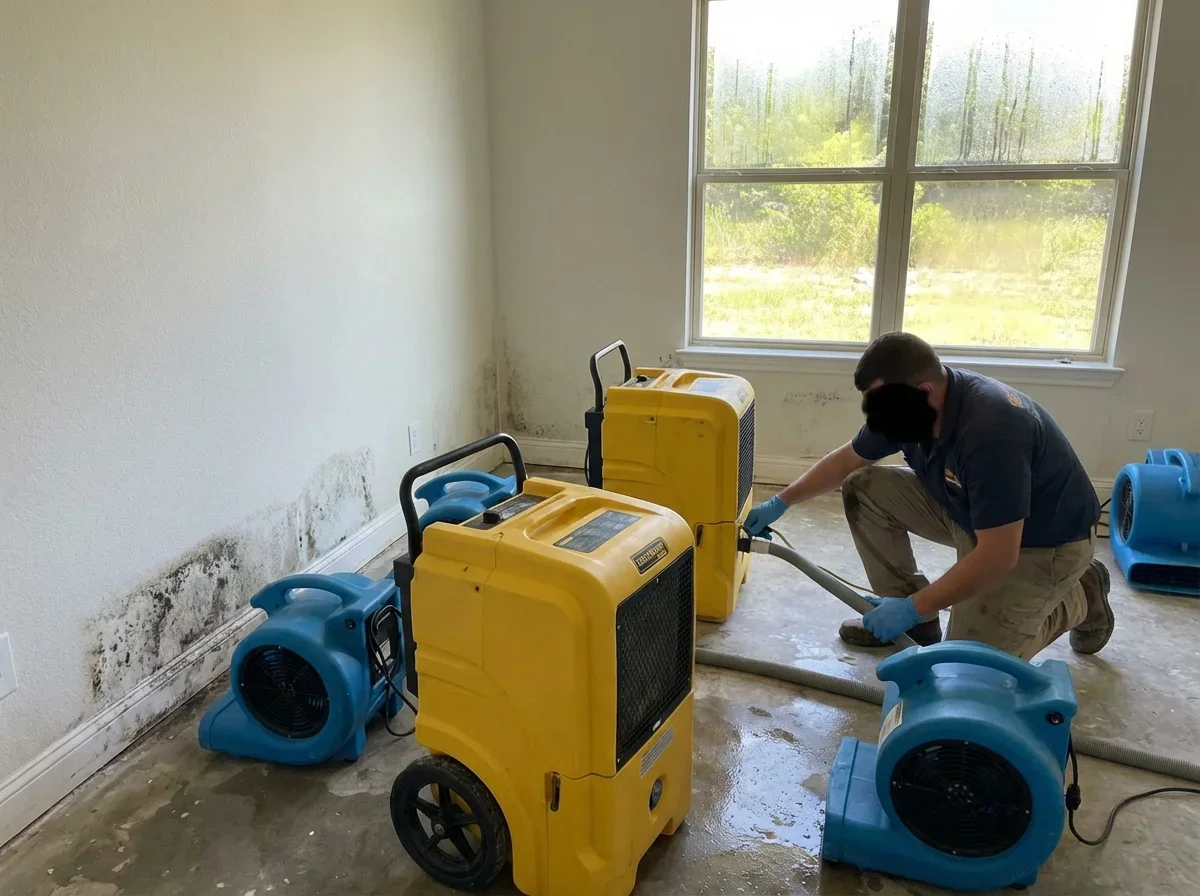
Industrial LGR (low-grain refrigerant) dehumidifiers can pull 150+ pints per day while maintaining 40-50% relative humidity, the range needed to halt mold growth. Air movement matters as much as dehumidification. High-velocity air movers create circulation that evaporates moisture from surfaces into the air where dehumidifiers can capture it. In Texas slab-on-grade homes, this often requires pulling baseboards and drilling small weep holes in drywall to direct airflow into wall cavities where moisture accumulates.
Exterior brick veneer — standard on Texas homes — creates a vapor barrier that traps moisture inside walls.
Moisture meters are the only way to confirm dryness. Wood framing should read below 15% moisture content before you close up walls. Drywall and concrete slabs need 48-72 hours of readings below 20% before you can safely install new flooring. Homeowners who skip this step and install new carpet over damp subflooring end up with recurring mold and that musty smell that won't resolve without tearing everything back out.
Dealing with Texas Slab Foundation Issues
Slab-on-grade construction creates unique post-flood challenges because plumbing runs beneath the concrete. Texas's expansive clay soil — dominant in Houston, Dallas-Fort Worth, and San Antonio — swells when saturated and shrinks when dry, causing slab movement that cracks copper and PVC pipes.
A flood event often reveals pre-existing slow leaks you didn't know existed.
Water that enters through slab cracks or failed pier-and-beam vapor barriers migrates laterally under flooring. You might see visible damage in your living room while the actual moisture source is 15 feet away under the master bathroom. Thermal imaging cameras detect these hidden moisture patterns by showing temperature differentials where evaporation is occurring — most professional mold inspection companies in Texas now use this technology during post-flood assessments.
Pier-and-beam homes (common in older neighborhoods across all Texas metros) have crawl spaces prone to standing water and poor ventilation. These spaces rarely have vapor barriers in homes built before 1990, and flooding fills them with contaminated water that evaporates upward into floor joists and subflooring. Crawl space mold removal in these situations requires encapsulation with reinforced polyethylene sheeting and permanent dehumidification.
Materials You Must Replace vs. What You Can Save
Hard non-porous materials survive flooding if dried within 48 hours: ceramic tile, sealed concrete, metal, and glass clean up with detergent and water. Solid wood furniture can usually be saved unless joints have separated.
Hard-surface engineered flooring (luxury vinyl plank, ceramic tile) survives if the subfloor underneath dried completely.
Anything porous that stayed wet past 72 hours gets discarded: drywall, insulation (fiberglass batts, cellulose, any non-closed-cell spray foam), carpet and padding, MDF trim, particle board, fabric-upholstered furniture, and mattresses. These materials absorb contaminated floodwater deep into their structure where you cannot effectively clean or disinfect.
The EPA's guidance is clear: porous materials with mold growth get removed and discarded, not cleaned.[1]
Wood framing occupies a middle category. Dimensional lumber (2×4 studs, floor joists) can be dried and treated if caught early and the moisture source eliminated. But engineered wood products common in post-2000 Texas construction — OSB subflooring, I-joists, engineered rim boards — delaminate when saturated and lose structural integrity. Insurance adjusters and engineers often require replacement even after drying because the materials' rated strength is compromised.
Pro Tip: Don't trust the "it looks dry" test. Materials that feel dry to the touch can retain 18-22% moisture content internally — well above the 15% threshold where mold thrives. A $30 moisture meter from any hardware store is the only reliable way to verify materials are safe to close up or cover with new flooring.
The Hidden Mold Timeline: What Happens Week by Week
Days 1-3: Mold spores (always present in air) land on wet surfaces and begin germinating. You won't see anything yet, but microscopic growth has started on any material above 20% moisture content.
This is your window to prevent mold entirely through aggressive drying.
Days 4-7: Visible mold colonies appear as spots or discoloration — usually gray, black, or greenish growth on drywall, wood, or paper-faced materials. Musty odor becomes noticeable as volatile organic compounds from mold metabolism fill the air.
At this stage you're already looking at remediation rather than just drying and cleaning.
Weeks 2-4: Mold spreads across surfaces and penetrates into porous materials. Wood framing develops fuzzy growth, insulation becomes matted and discolored, and colonies become established enough to produce spores continuously. Anyone with mold sensitivity starts experiencing symptoms — respiratory irritation, headaches, fatigue. The scale has likely exceeded what the EPA considers homeowner-manageable.[2]
Month 2+: Structural damage begins. Mold digests cellulose and lignin in wood and paper, weakening materials. Drywall becomes friable, studs show soft rot, and the mold smell permeates belongings throughout the home.
At this stage you're looking at whole house mold remediation with extensive demolition and rebuilding.
Insurance Claims and Documentation Strategy
Texas homeowners insurance excludes flood damage (that requires separate NFIP or private flood insurance), but sudden water damage from storm-related roof leaks, burst pipes, or HVAC failures is covered. The distinction matters: if Hurricane Beryl's storm surge flooded your home, that's flood insurance. If Beryl's winds tore off shingles and rain entered, that's homeowners.
Document everything before you touch it — your claim's success often depends on proving what was damaged and when. Take photos of water lines on walls showing flood height, date-stamped video walking through each room, and close-ups of damaged materials and belongings. Save examples of damaged materials (a piece of moldy drywall, wet insulation) in sealed bags.
Insurance adjusters are trained to look for pre-existing conditions and undocumented damage.
File your claim within 72 hours even if you're still assessing damage — insurers track reporting speed and may question claims filed weeks later. Ask your adjuster specifically about coverage for temporary housing if your home is uninhabitable and for contents cleaning and restoration of salvageable belongings. Many Texas homeowners don't realize these are covered benefits that can reduce out-of-pocket costs substantially.
Preventing Mold Recurrence After Cleanup
Eliminating the moisture source is the only permanent solution. If flooding came from outside (storm surge, river overflow), you're looking at site grading, French drains, or even elevation if you're in a repetitive-loss flood zone.
Most Texas flood recurrence comes from inside: foundation settling that cracks slab plumbing, HVAC condensate line failures, or roof leaks from hail damage.
Texas's clay soil requires active foundation maintenance. During droughts, soil contracts and pulls away from your slab. When saturated, it expands and exerts pressure. This cycle creates the foundation movement that cracks plumbing and opens gaps at the slab perimeter. A soaker hose on a timer maintaining consistent soil moisture 18 inches from your foundation reduces movement — this simple $50 intervention prevents thousands in future water damage.
AC drain pans overflow when condensate lines clog with algae and debris, a constant issue when systems run 8+ months annually. Install an overflow shutoff switch (required by code in newer Texas homes) that kills the AC if the pan fills.
A $75 part that prevents attic flooding and subsequent attic mold removal that costs $4,000-8,000 in Texas markets.
Health Considerations and When to Leave Your Home
Mold exposure health effects vary by individual sensitivity, but the CDC and EPA agree that extensive mold growth creates respiratory risks for everyone. If you can smell mold or see growth across multiple rooms, particularly if anyone in your household has asthma or immune system compromise, temporary relocation during remediation is advisable.
Texas's lack of mold exposure regulations means there's no legal threshold for "unsafe" indoor mold levels — it's a judgment call. Professional assessors measure airborne spore counts and compare them to outdoor baseline, but interpretation varies. Generally, if indoor spore counts exceed outdoor levels by 10x or more, or if toxic species like Stachybotrys (black mold) are present at any elevated level, remediation should proceed with the home unoccupied.
Post-remediation verification testing confirms the work was successful. A TDLR-licensed assessor (must be different from the company that performed remediation) collects air and surface samples 24-48 hours after final cleaning. Results should show spore counts at or below outdoor levels and no amplification of water-damage indicator species.
Don't accept verbal assurances — get laboratory reports showing spore counts by genus.
Why Texas Remediation Costs Are Higher Than National Averages
The combination of TDLR licensing requirements, separate assessment mandates, and Texas's construction practices drives remediation costs 15-25% above national averages. You can't combine assessment and remediation with one company (saving 20-30% in duplicate mobilization fees), and licensed companies carry higher insurance costs than unlicensed competitors in other states.
Slab-on-grade remediation requires specialized equipment to dry subfloor moisture without demolishing the entire slab — injection drying systems, subslab vacuum systems, and thermal imaging all add to costs. Brick veneer exterior walls (standard on 70%+ of Texas single-family homes) trap moisture and often require removal of exterior brick to dry wall cavities properly, something rarely needed in wood-sided homes common in other regions.
Hurricane and severe storm frequency keeps demand consistently high in Texas coastal and East Texas markets. Post-Harvey (2017) Houston created permanent capacity increases and higher baseline pricing that hasn't receded.
Licensed remediation companies in major Texas metros carry backlog schedules during peak season (May-October) that allow premium pricing for immediate response.
Finding TDLR-Licensed Help: Red Flags and Green Flags
Verify licensing first, before any other evaluation. Texas requires separate licenses for mold assessment companies, mold assessment consultants, mold remediation contractors, mold remediation workers, and mold remediation companies.
Search the company and individual technician names at https://www.tdlr.texas.gov/mol/mol.htm — if they don't appear, they're operating illegally regardless of what their website claims.
Red flags: Combined assessment and remediation services under one company name (violates TDLR rules), pressure to sign a remediation contract before receiving a written protocol from an independent assessor, pricing based on mold test results rather than scope of work ("we charge per spore count"), lack of specific insurance coverage (general liability doesn't cover pollution or professional errors), and inability to provide references from recent similar projects.
Green flags: Separate assessment and remediation companies (following TDLR rules), detailed written protocols following IICRC S520 standards, itemized estimates with material specifications, proof of pollution and professional liability insurance, and willingness to coordinate directly with your insurance adjuster.
The best Texas remediation contractors maintain relationships with multiple assessment firms and can recommend options without conflicts of interest.
- U.S. Environmental Protection Agency (EPA). "Homeowner's and Renter's Guide to Mold Cleanup after Disasters." https://www.epa.gov/mold/homeowners-and-renters-guide-mold-cleanup-after-disasters. Accessed April 02, 2026.
- U.S. Environmental Protection Agency (EPA). "Mold Cleanup in Your Home." https://www.epa.gov/mold/mold-cleanup-your-home. Accessed April 02, 2026.
- U.S. Department of Housing and Urban Development (HUD). "Mold Removal Guidelines for Your Flooded Home." https://www.hud.gov/sites/documents/doc_10722.pdf. Accessed April 02, 2026.