Why Texas Homes Have Higher Mold Risk Than Most States
Texas construction and climate create a perfect storm for hidden mold. The majority of homes built after 1980 sit on slab-on-grade foundations — no basement, no crawl space in most cases, just concrete poured directly on expansive clay soil. When that clay swells with moisture or shrinks during drought, it shifts the foundation. Hairline cracks form in the slab and in the plumbing lines running underneath it.
Water seeps in slowly, pooling beneath flooring or inside wall cavities where you'll never see it until mold blooms.
Add year-round air conditioning to the equation. AC condensate drain pans overflow, ductwork sweats in attics where summer temperatures hit 140°F, and humidity condenses on cold supply vents. Homeowners in Houston, Dallas, and San Antonio routinely find black streaks around registers and musty smells emanating from return air grilles — signs of mold in air ducts that spread spores throughout the home every time the system runs.
Texas is also one of the few states with dedicated mold licensing regulations. The Texas Department of Licensing and Regulation (TDLR) requires separate licenses for mold assessment and mold remediation under the Texas Mold Assessment and Remediation Rules (TMARR). You can verify any company's credentials at https://www.tdlr.texas.gov/mol/mol.htm.
This regulatory framework exists because the problem is pervasive enough to warrant state-level oversight — a red flag most buyers don't consider until they're already in contract.
Pro Tip: Texas is one of only a handful of states that requires separate licensing for mold assessment and remediation. This isn't bureaucratic overreach — it's a response to widespread contamination issues that affect thousands of homes annually. If your state doesn't regulate mold work, that doesn't mean the risk is lower; it just means you have less legal protection.
What a Pre-Purchase Mold Inspection Actually Covers
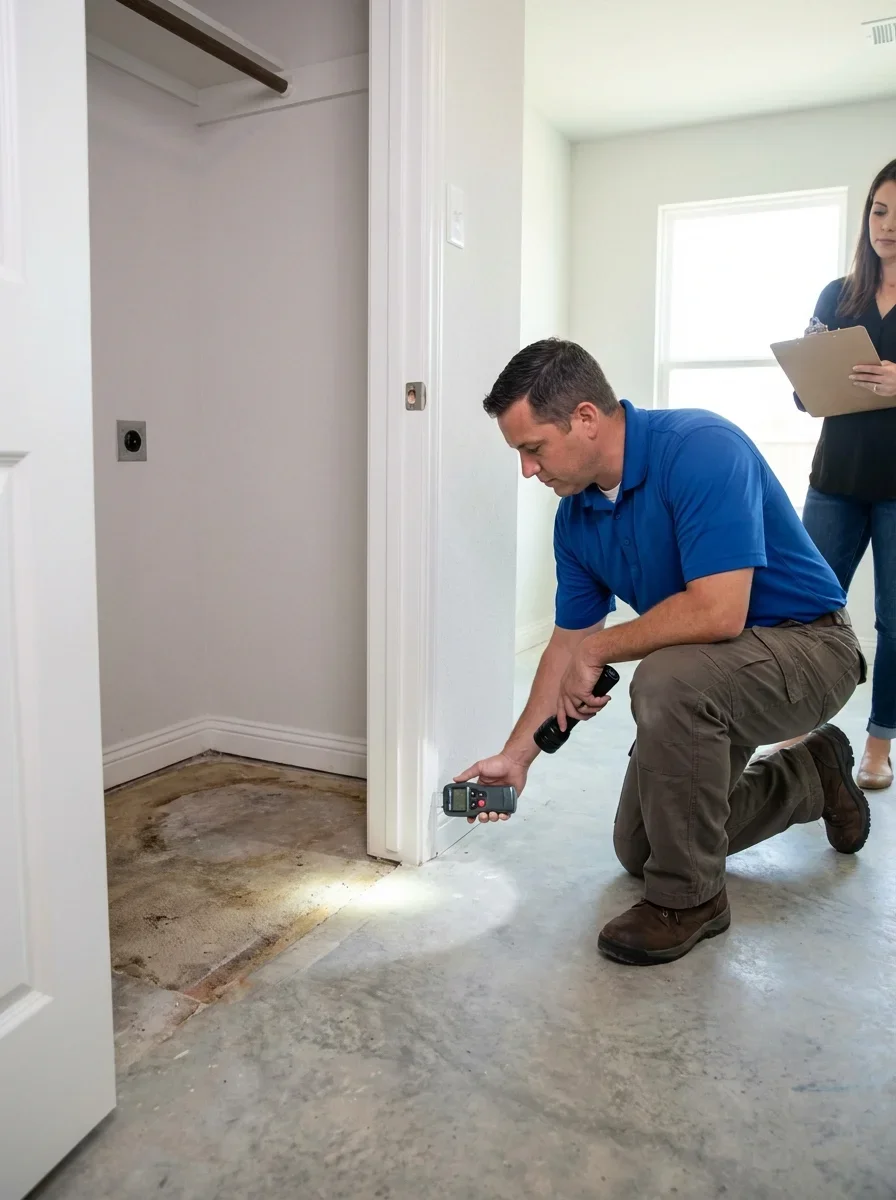
A mold inspection is not the same as mold testing. The inspection is a visual assessment combined with moisture detection and environmental sampling where warranted. A TDLR-licensed Mold Assessment Technician walks the property with thermal imaging cameras, moisture meters, and a checklist of high-risk areas. They're looking for visible growth, water intrusion patterns, elevated humidity readings, and conditions that support mold colonization.
In Texas homes, inspectors prioritize attics (where radiant heat and poor ventilation trap moisture), HVAC systems (condensate pans and ductwork), bathrooms (especially around tubs and behind tile), laundry rooms, and the perimeter of slab foundations where plumbing enters the home. Pier-and-beam homes — common in older neighborhoods across Austin, Fort Worth, and East Texas — get crawl space inspections, since those voids are notorious for moisture accumulation and poor ventilation.
If the inspector finds visible mold or conditions suggesting hidden growth, they may recommend air sampling or surface sampling. But here's what most buyers don't realize: sampling is rarely necessary to make a decision. The EPA explicitly states that if visible mold growth is present, sampling is unnecessary since no federal limits exist for mold concentrations, and you can't use lab results to prove compliance with any standard.[1]
The CDC echoes this — identifying the mold species doesn't change the remediation approach; finding and eliminating the moisture source does.[2]
That said, air sampling can help quantify the extent of contamination in HVAC systems or wall cavities, and it provides a baseline for post-remediation verification if you proceed with the purchase and hire a remediation company. Just know that testing adds $300–$600 to your inspection cost, and in most cases, the visual assessment alone tells you what you need to know.
How Much Does a Pre-Purchase Mold Inspection Cost in Texas?
Expect to pay $400–$700 for a standard residential mold inspection covering a typical 2,000–2,500 sq ft home. Larger homes, properties with pier-and-beam construction (which require crawl space access), or homes with known water damage history may run $800–$1,200. If air or surface sampling is recommended, add $100–$150 per sample; most inspections involve 2–4 samples if any are taken at all.
This cost is separate from your general home inspection and typically isn't covered by your lender or real estate agent. You pay out of pocket during the option period, which in Texas usually runs 7–10 days after your offer is accepted.
The investment is minor compared to discovering a $15,000 whole house mold remediation problem after you've closed.
| Service Type | What's Included | Typical Cost | When You Need It |
|---|---|---|---|
| Visual-Only Inspection | Moisture mapping, thermal imaging, visual assessment | $400–$700 | Standard due diligence on homes without obvious water damage |
| Inspection + Air Sampling | All visual services plus 2–4 air samples, lab analysis | $700–$1,200 | Homes with musty odors, HVAC concerns, or suspected hidden contamination |
| Comprehensive Assessment | Visual inspection, multiple air/surface samples, crawl space or attic access | $1,000–$1,500 | Older homes, pier-and-beam construction, or properties with documented water damage history |
When to Schedule the Inspection (And What Happens If You Wait)
Order the mold inspection as soon as your option period begins, ideally within 24–48 hours of going under contract. You're already paying for a general home inspection — schedule both on the same day if logistics allow, but don't assume your home inspector will catch mold issues. Most won't enter attics in summer (too hot), won't open HVAC ductwork, and won't use thermal imaging to detect moisture behind drywall.
If your general inspector flags water stains, active leaks, or musty odors in their report, that's your cue to bring in a mold specialist immediately. You'll lose negotiating leverage if you wait until day 6 of a 7-day option period to discover contamination — sellers know you're under time pressure and may refuse concessions or remediation credits.
Worse, if you waive your option period (common in competitive markets), you lose the contractual right to back out without forfeiting your earnest money.
Texas buyers often regret skipping the mold inspection on newer homes. "The house was built in 2019, so I didn't think mold would be an issue," one buyer in Round Rock shared. "Turns out the builder never connected the AC condensate drain properly. Water had been dripping into the wall cavity for three years." That mistake cost $8,500 in remediation and delayed closing by two weeks.
New construction in fast-growing metros like Austin, San Antonio, and North Dallas frequently has moisture management defects — improper flashing around windows, missing vapor barriers, or poorly sealed ductwork. A new construction mold inspection catches these builder defects before they become your liability.
What Triggers Mold in Texas Homes (And What Inspectors Look For)
Slab leaks are the #1 culprit statewide. Hard water in San Antonio and the Hill Country — often exceeding 300 ppm calcium carbonate — accelerates copper pipe corrosion. Pipes under the slab develop pinhole leaks that seep water into the concrete and subfloor for months before anyone notices. By the time you see warped flooring or feel a soft spot in the carpet, mold is already established.
Inspectors use moisture meters to probe flooring and baseboards, looking for elevated readings that indicate hidden water.
HVAC condensate issues rank second. Central AC systems in Texas run from March through November; condensate drain pans fill with water and overflow if the drain line clogs (which happens constantly in dusty regions like West Texas and the Panhandle). Water drips into ceiling cavities, insulation, or ductwork. Inspectors pull air filters, inspect drain pans, and use borescopes to examine ductwork interiors for microbial growth.
Foundation movement from expansive clay creates chronic moisture intrusion. When the clay shrinks during drought, gaps open between the slab and perimeter walls. Rainwater and irrigation runoff seep into those gaps. When the clay swells after heavy rain, it compresses the slab and cracks plumbing connections.
This cycle repeats every season.
Houston, Dallas-Fort Worth, and San Antonio all sit on Blackland Prairie or Gulf Coast clay soils that exhibit extreme swell-shrink behavior. Inspectors examine foundation grading, downspout placement, and interior cracks for signs of moisture penetration.
Roof leaks and attic ventilation failures are pervasive in two-story tract homes built after 2000. Complex rooflines with multiple valleys trap debris and standing water. Inadequate attic ventilation (common in value-engineered new construction) allows summer heat and humidity to condense on roof decking. Inspectors enter attics with thermal cameras to detect temperature differentials that indicate wet insulation or active leaks.
Top 5 Mold Triggers Texas Inspectors Find Most Often:
- Slab leaks from corroded copper pipes — common in hard water areas (San Antonio, Hill Country); often undetected for 6–12 months
- HVAC condensate drain failures — clogged lines cause overflow into ceilings, walls, and ductwork
- Foundation movement from expansive clay — creates seasonal gaps that allow water intrusion around perimeter walls
- Roof valley failures and inadequate attic ventilation — trap moisture in roof decking and insulation in two-story homes
- Improperly sealed crawl spaces — pier-and-beam homes in older neighborhoods lack vapor barriers and drainage
How to Read Your Mold Inspection Report (And What Actually Matters)
Your report will include a narrative summary, annotated photos, moisture readings, and air/surface sample results if testing was performed. The most critical section is moisture documentation. Any reading above 15–17% moisture content in wood or drywall indicates active water intrusion.
Readings in the 20–30% range mean prolonged exposure and likely mold colonization.
Thermal imaging photos show temperature variations — cooler spots often indicate moisture because evaporation lowers surface temperature. If you see blue or purple zones on thermal images around plumbing penetrations, windows, or ceilings, that's evidence of hidden water. Inspectors will mark these areas as "requiring invasive investigation," meaning they recommend opening the wall or ceiling to confirm conditions.
If air sampling was performed, you'll see spore counts for various mold types measured in spores per cubic meter (spores/m³). The outdoor control sample is the benchmark. Indoor counts significantly higher than outdoor counts suggest an active indoor source. The specific mold species matters less than the concentration delta — 10,000 spores/m³ indoors versus 500 spores/m³ outdoors is a red flag regardless of whether the dominant species is Aspergillus, Penicillium, or Stachybotrys (black mold).
Most reports conclude with one of three recommendations: (1) no action needed, (2) moisture correction required but no remediation, or (3) professional remediation required under TDLR rules. Texas law mandates a remediation notification to TDLR when mold contamination affects 25 contiguous square feet or more on residential properties.[3]
If your report identifies contamination exceeding that threshold, you're legally required to hire a licensed Mold Remediation Company — not a handyman, not a general contractor, and not the same company that performed the assessment (dual licensing is prohibited in Texas).
For help interpreting technical language and lab results, see Understanding Your Mold Assessment Report.
How to Use Inspection Results in Negotiations (Without Killing the Deal)
You have three options when mold is confirmed: request remediation before closing, negotiate a credit to handle it yourself post-closing, or walk away.
Each has trade-offs.
Requesting pre-closing remediation is the cleanest path if contamination is significant. The seller hires a TDLR-licensed remediation company, the work is completed during your option period or before closing, and you receive a post-remediation verification report confirming clearance. This protects you fully but requires the seller to cooperate, extends closing timelines, and may involve permit delays if the underlying cause (roof repair, plumbing replacement, HVAC work) triggers municipal permit requirements.
Negotiating a credit gives you control over contractor selection but means you're buying a home with active contamination. You'll close on schedule, receive a lump sum credit (or seller-paid closing costs), and hire your own remediation company after taking ownership. This works well for localized issues (bathroom mold, small attic section) but exposes you to cost overruns if the problem is worse than estimated.
Get at least two written remediation bids before agreeing to a credit amount — remediation costs in Texas range from $1,500 for a single bathroom to $25,000+ for whole-house contamination with structural repairs. For cost benchmarking, review How Much Does Mold Remediation Cost in Texas?.
Walking away is the right call if contamination is pervasive, the moisture source is unresolved (active foundation leak, chronic roof failure), or the seller refuses concessions. You forfeit your option fee (typically $100–$500) but preserve your earnest money and avoid inheriting a money pit.
Buyers who ignore inspection findings and close anyway often face insurance claim denials — Texas homeowners policies exclude mold damage resulting from long-term neglect or pre-existing conditions. For insurance specifics, see Does Homeowners Insurance Cover Mold in Texas?.
What If the Seller Won't Budge?
In competitive markets (Austin's northwest suburbs, Dallas's Frisco/McKinney corridor, Houston's Energy Corridor), sellers sometimes reject all repair requests, knowing another buyer will accept the property as-is. If you're emotionally attached to the home and the mold issue is isolated and fixable, consider this: a $5,000 remediation cost on a $400,000 home is 1.25% of the purchase price.
You might absorb that cost yourself rather than lose the deal — but only if the underlying cause is identified and repairable.
If the inspector notes "foundation movement causing chronic moisture intrusion" or "HVAC system undersized for square footage, causing humidity and condensation," you're looking at ongoing maintenance nightmares, not a one-time fix.
Get a second opinion if you're uncertain. Bring in a structural engineer for foundation concerns, a licensed plumber for slab leak suspicions, or an HVAC contractor for system capacity issues. Spending another $300–$500 for specialist diagnostics can save you $30,000 in post-purchase regret.

Common Red Flags Texas Buyers Overlook (That Inspectors Catch)
Musty odors with no visible source rank as the most ignored warning sign. Buyers assume the smell is just "old house" character or poor ventilation. Inspectors know it indicates active microbial growth in wall cavities, under flooring, or in HVAC ductwork.
If you smell mildew or earthiness in any room, demand an inspection — even if you see no stains or discoloration. For odor-specific guidance, see Mold Odor Removal.
Recent cosmetic updates in moisture-prone areas are another red flag. Freshly painted bathrooms, new carpet in a bedroom with an exterior wall, or recent tile work around a tub may be covering up prior water damage. Inspectors probe behind vanities, pull back carpet edges, and use thermal imaging to detect concealed moisture — don't let aesthetic upgrades lull you into skipping due diligence.
Dehumidifiers or portable AC units in closets, bathrooms, or garages signal chronic moisture problems the seller is actively managing. Ask why they're there. If the answer is vague ("the previous owner left them"), dig deeper.
Homes in humid East Texas — Houston, Beaumont, Tyler — often need supplemental dehumidification, but it should be integrated into the HVAC system, not jury-rigged with standalone units draining into utility sinks.
Overgrown landscaping against the foundation creates perpetual moisture and blocks airflow. Shrubs, mulch beds, and flower boxes piled against brick veneer trap irrigation water and rainwater against the slab perimeter. Over time, water seeps through mortar joints and enters wall cavities. Inspectors flag this because it's a maintenance issue that becomes a mold issue if ignored.
You can fix it post-purchase, but if water intrusion has already occurred, you're buying someone else's deferred maintenance.
Choosing a TDLR-Licensed Mold Assessment Company in Texas
Texas law distinguishes between Mold Assessment Technicians and Mold Remediation Workers — and the same company cannot perform both services on the same property. This rule exists to prevent conflicts of interest (an assessor inflating the scope of work to benefit their remediation arm). When selecting an inspector, verify their TDLR license status at https://www.tdlr.texas.gov/mol/mol.htm and confirm they do assessment only, not remediation.
Look for companies that carry general liability insurance, professional liability (errors and omissions) coverage, and pollution liability insurance. Texas doesn't require general contractors to carry workers' compensation (it's one of the few states without that mandate), but reputable mold companies carry it anyway to protect you from liability if a technician is injured on your property.
Ask about equipment. Thermal imaging cameras, moisture meters, and borescopes are standard tools for thorough assessments.
If the company relies solely on visual inspection and doesn't own diagnostic equipment, move on. Mold in Texas homes is often hidden behind drywall, under flooring, or in ductwork — you need technology to find it.
For a comprehensive vetting checklist, review Questions to Ask Before Hiring a Mold Company in Texas and How to Choose a Mold Remediation Company in Texas (the latter applies equally to choosing an assessor).
What Happens After You Get the Report
If the report comes back clean, you've gained peace of mind and documentation to support your purchase decision. Keep the report in your home records — it establishes a baseline for future claims and proves you performed due diligence.
If contamination is confirmed, act within your option period. In Texas, the option period is a hard deadline — you must notify the seller in writing of any repair requests or intent to terminate before it expires, typically by 5 PM on the final day.
Miss the deadline and you lose your right to negotiate or walk away without penalty.
Request remediation quotes from at least two TDLR-licensed Mold Remediation Companies. Share the assessment report with them so they can provide accurate estimates. Quotes should itemize containment setup, removal and disposal, structural drying, HVAC cleaning, and post-remediation verification testing. If any contractor suggests skipping verification testing or offers to "handle the assessment and remediation together" (illegal in Texas), eliminate them immediately.
Submit repair requests via your real estate agent using the standard TREC Amendment to Contract form. Be specific: "Seller to remediate mold contamination in master bathroom and attic per assessment report dated [date], using TDLR-licensed contractor, with post-remediation verification and clearance report provided to buyer prior to closing." Vague requests ("Seller to address mold issues") give the seller wiggle room to do substandard work.
If negotiations fail, terminate the contract in writing before your option period ends. You'll lose your option fee but recover your earnest money.
Consult your agent and possibly a real estate attorney if the seller disputes termination or withholds earnest money — Texas law strongly favors buyers who terminate during the option period for any reason.
Protecting Yourself If You Buy a Home With Known Mold

Sometimes you'll proceed with a purchase knowing mold is present — maybe you negotiated a $10,000 credit, or the home is otherwise perfect and the contamination is minor. If so, hire your own remediation company immediately after closing. Don't delay. Mold spreads rapidly in Texas humidity, and every week you wait compounds the problem.
Document everything. Take photos and videos of all affected areas before remediation begins. Keep copies of the assessment report, remediation contract, invoices, and clearance testing results.
If you ever file an insurance claim (for a separate incident) or sell the home, this documentation proves you addressed the issue properly.
Consider an indoor air quality test six months post-remediation to confirm the problem hasn't recurred. Recurring mold almost always indicates an unresolved moisture source — a plumbing leak that wasn't fully repaired, inadequate attic ventilation, or foundation grading that directs water toward the home. For recurring issues, see Why Mold Keeps Coming Back After Remediation.
Update your homeowners insurance policy. Some insurers exclude mold coverage entirely; others cap it at $5,000–$10,000. If you live in a high-risk area (Houston's flood zones, older neighborhoods with pier-and-beam construction, homes on expansive clay), consider a separate mold endorsement or a policy with higher limits.
Disclose the prior mold issue when applying for new coverage — non-disclosure can void your policy.
Why Texas Mold Inspections Are Non-Negotiable in These Situations
Certain property types demand mold inspections regardless of age or apparent condition:
Homes with prior flood or storm damage, especially post-Harvey properties in Houston, post-freeze homes from Winter Storm Uri (February 2021), or any property in FEMA flood zones. Even if repairs were documented, moisture can linger in wall cavities and under flooring for years. For storm-specific concerns, see Storm Damage Mold Remediation.
Pier-and-beam homes in older neighborhoods (East Dallas, Austin's Hyde Park, Houston Heights, Fort Worth's Fairmount). Crawl spaces are moisture traps, and many of these homes predate modern vapor barriers. See Crawl Space Mold Removal for what to expect.
Homes with finished attics or bonus rooms built after 2000. Builders often cut corners on attic HVAC ducting and insulation in these spaces. Condensation inside ducts and inadequate ventilation create mold hotspots. Attic Mold Removal details typical contamination patterns.
Properties sold as-is or bank-owned (REO/foreclosures). These homes sat vacant, often with utilities shut off and no climate control. Humidity condenses, pipes leak undetected, and mold flourishes. An inspection is your only protection against hidden damage.
Homes in San Antonio, Austin, and the Hill Country where hard water exceeds 300 ppm. Accelerated pipe corrosion under slab-on-grade foundations creates slab leaks that go undetected until flooring buckles or water bills spike. Moisture meters can detect these leaks before visible damage appears.
What Buyers Wish They'd Known (Straight from Experience)
The biggest regret? Trusting the general home inspector to catch mold.
"Our inspector noted a 'musty smell in the master closet' but didn't recommend further investigation," one buyer in Katy recalled. "We figured it was just carpet odor. After closing, we found black mold covering the entire back wall — a slow roof leak the seller had patched but never remediated. Cost us $12,000 and three weeks in a hotel." A $500 mold inspection would have flagged the issue during the option period when the seller was still on the hook.
Second regret: accepting seller credits without getting independent remediation quotes. "The seller offered $3,000 to 'handle the mold in the garage,'" a buyer in Plano shared. "Actual cost was $7,500 because the moisture had spread into the drywall and insulation. We ate the difference."
Always get your own quotes before agreeing to credit amounts — sellers will lowball to minimize their expense.
Third regret: skipping the inspection on new construction. "We bought a 2023 build in Leander and assumed everything was perfect," an Austin-area buyer said. "Eight months in, we found mold in the HVAC closet — the builder never insulated the ductwork in the attic, and condensation dripped onto the drywall. Builder's warranty covered the repair, but we lived with mold for months before discovering it."
New homes in fast-growth submarkets often have punch-list defects that cause moisture problems within the first year.
The Bottom Line: What a $500 Inspection Buys You
A mold inspection before buying a home in Texas is not just about finding mold — it's about understanding what you're buying and who's paying to fix it. You're verifying that the home's moisture management systems (foundation, HVAC, plumbing, roof) actually work, not just assuming they do because the house looks clean.
You're gaining leverage to negotiate repairs or walk away while you still can. And you're protecting yourself from the most common post-purchase nightmare in Texas real estate: discovering hidden water damage three months after closing, when your options are file a claim (likely denied), sue the seller (expensive and time-consuming), or pay out of pocket (financially devastating).
The inspection costs $400–$700. The average mold remediation project in Texas costs $4,500–$8,500.
The peace of mind? Priceless.
- US Environmental Protection Agency (EPA). "A Brief Guide to Mold, Moisture and Your Home." https://www.epa.gov/mold/brief-guide-mold-moisture-and-your-home. Accessed April 02, 2026.
- Texas Department of Licensing and Regulation (TDLR). "Consumer Protection - mold.pdf." https://www.tdlr.texas.gov/media/pdf/Consumer%20Protection%20-%20mold.pdf. Accessed April 02, 2026.
- Texas Department of Licensing and Regulation (TDLR). "Texas Mold Remediation Notification Requirements." https://www.tdlr.texas.gov/mld/mldnotifications.htm. Accessed April 02, 2026.