When Air Quality Testing Actually Makes Sense
If you can see mold growth on your drywall or ceiling tiles, you don't need a lab report to confirm it's mold. You need it gone.
But there are specific situations where air testing provides information you can't get any other way.
You Smell Mold But Can't Find the Source
A persistent musty odor — especially one that strengthens when the AC kicks on — often means hidden growth inside wall cavities, ductwork, or under flooring. In Texas homes built on slab foundations, slow plumbing leaks beneath the concrete can saturate insulation and lumber for months before you notice anything at the surface.
Air sampling can detect elevated spore counts that point you toward the hidden moisture source, especially when paired with moisture mapping and thermal imaging during a mold inspection.
One Houston homeowner discovered this the hard way after months of complaints about headaches and a "swampy" smell in the master bedroom. Visual inspection found nothing. Air testing showed Stachybotrys concentrations 40 times higher than outdoor baseline — and eventually led to a corroded copper pipe buried two feet under the slab.
After Remediation to Verify Clearance
Texas Department of Licensing and Regulation (TDLR) rules under the Texas Mold Assessment and Remediation Rules (TMARR) don't legally require post-remediation air testing, but many remediation contracts include it as proof the job is complete. This is called clearance testing or post-remediation verification, and it's your only objective way to confirm spore counts have returned to normal levels after containment and removal.
Here's the catch: the company that does the remediation cannot perform the clearance test.
TDLR requires separate Mold Assessment and Mold Remediation licenses, and the same entity can't hold both for the same project. You'll need an independent assessor — verify their license at tdlr.texas.gov/mol/mol.htm before they start work.
Pro Tip: Always verify BOTH the individual technician's license AND the company's license at tdlr.texas.gov before signing any contract. Unlicensed assessment work voids remediation warranties and violates Texas law.
During Real Estate Transactions
Buyers increasingly request air quality testing when purchasing older homes or properties with a history of water damage. It's not required by Texas law, but it's become common practice in post-Harvey Houston, where flood history raises red flags.
If the seller's disclosure mentions prior water intrusion or you're buying a pier-and-beam home with a crawl space, baseline air testing gives you leverage to negotiate repairs or walk away before closing.
One Austin buyer used pre-purchase air testing to discover hidden attic mold in a 1985 home with a documented roof leak from three years prior. The seller claimed it had been "fixed," but spore counts were 10x outdoor levels. The buyer negotiated $8,500 off the purchase price to cover professional attic mold removal.
Health Symptoms Without an Obvious Cause
If multiple household members are experiencing respiratory issues, chronic sinus infections, or unexplained fatigue, and your doctor suspects environmental triggers, air testing can help rule mold in or out.
Keep in mind that mold sensitivity varies wildly between individuals. Some people tolerate high spore counts with no symptoms, while others react to concentrations barely above outdoor levels.
The CDC is clear: air sampling won't tell you if someone will get sick, because there are no established exposure limits.[2] But it can confirm whether your indoor air contains significantly elevated spore levels compared to outdoor air, which is the only meaningful benchmark.
The Three Main Types of Mold Air Testing
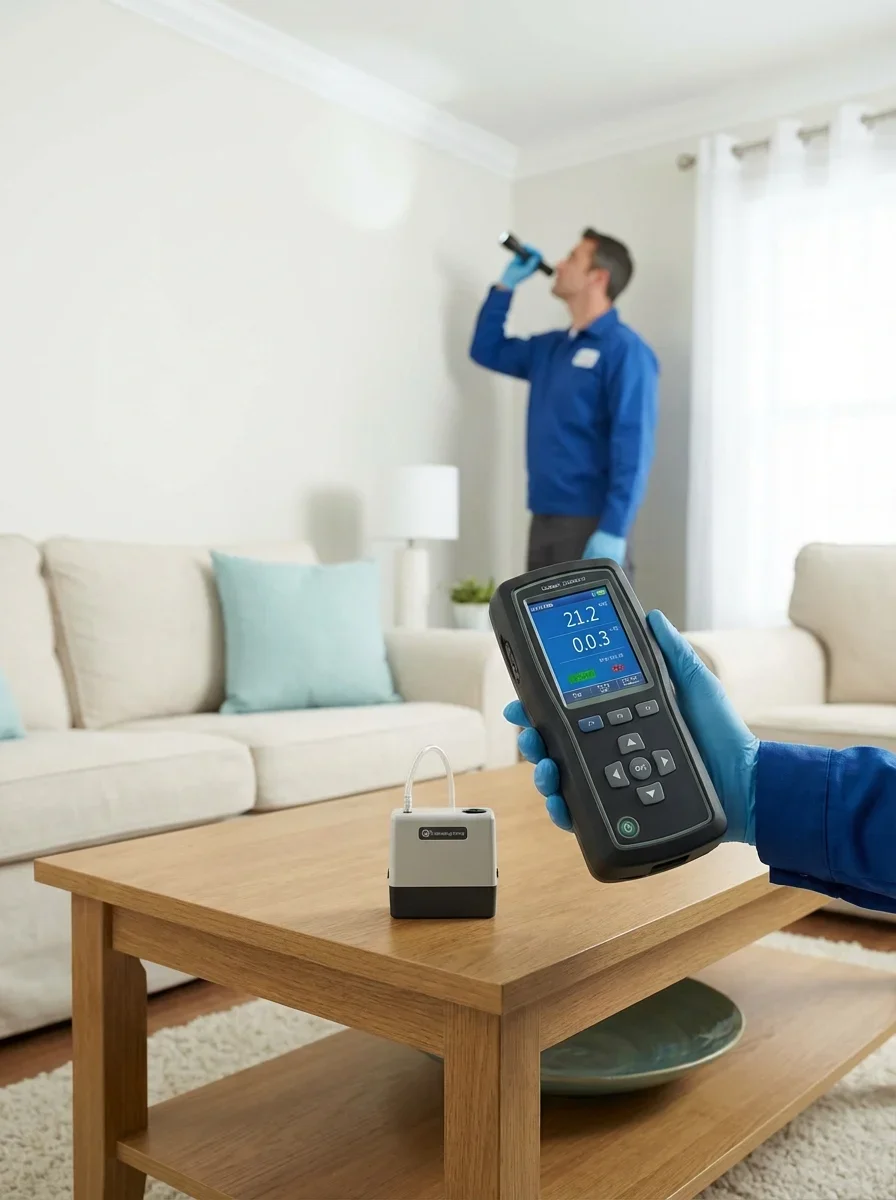
Not all air tests measure the same thing. Understanding the differences helps you avoid paying for data you don't need.
Spore Trap Air Sampling
This is the most common method. A calibrated air pump pulls a known volume of air through a collection device that traps airborne spores on a sticky slide. The slide goes to a lab, where a technician counts and identifies spore types under a microscope.
You'll get results showing spore concentrations (spores per cubic meter) broken down by genus: Aspergillus, Penicillium, Cladosporium, Stachybotrys, and others.
Spore trap sampling gives you a snapshot of what's floating in the air at the moment of collection — usually a 5-10 minute sample. It's fast and relatively affordable ($75-150 per sample in Texas), but it misses mold that isn't actively releasing spores during that narrow window. If the HVAC system is off or humidity is low, counts can be deceptively low even when there's significant hidden growth.
Viable Air Sampling (Culture Plates)
Culture-based sampling uses a pump to force air across a petri dish filled with growth medium. The dish incubates for 5-7 days, and any mold spores that land on it grow into visible colonies. The lab then identifies species and reports Colony Forming Units (CFUs).
Culture sampling takes longer and costs more ($150-250 per sample), but it provides two advantages: it can identify mold species with greater precision, and it tells you whether the spores are viable (capable of growing).
The downside is that many common indoor molds don't culture well, so you can underestimate the problem. It's rarely the first choice unless you're dealing with suspected toxigenic species or need forensic-level identification.
Real-Time PCR and DNA-Based Testing
Newer methods use DNA analysis (ERMI, HERTSMI-2, or qPCR) to detect mold presence and quantify specific species. Some services use handheld devices that provide instant results. These tests are expensive ($300-700+) and not widely used in residential assessments, though they're gaining traction for litigation cases and complex commercial projects.
The main advantage is speed and specificity — you get a genetic fingerprint of what's in your air.
The main disadvantage is cost and interpretation complexity. Most Texas homeowners don't need this level of detail unless they're pursuing an insurance claim or lawsuit.
| Testing Method | Cost Per Sample | Turnaround Time | Best For |
|---|---|---|---|
| Spore Trap | $75-150 | 5-7 days | General screening, post-remediation clearance |
| Culture Plate | $150-250 | 7-10 days | Species identification, viability confirmation |
| DNA/PCR | $300-700+ | 24-48 hours | Litigation, insurance claims, complex cases |
How to Interpret Your Air Test Results
You get the lab report back. Now what?
Here's the problem: without federal standards, there's no magic number that says "this air is safe" or "this air is dangerous."[3]
Outdoor vs. Indoor Comparison
The only useful benchmark is outdoor air on the same day. A proper air quality test always includes at least one outdoor control sample collected at the same time as indoor samples.
If your indoor spore count is significantly higher than outdoor — usually 2-3x or more — that suggests an indoor amplification source.
But Texas outdoor air naturally contains high mold spore counts, especially during humid months. Outdoor baselines in Houston from May through October routinely hit 10,000-20,000 spores/m³, dominated by Cladosporium and Aspergillus. If your indoor count is 8,000 and outdoor is 15,000, you're fine. If indoor is 25,000 and outdoor is 5,000, you have a problem.
Species Matters More Than Count
Absolute numbers tell part of the story. Species composition tells the rest.
High concentrations of water-damage indicators like Stachybotrys, Chaetomium, or Fusarium — even in moderate numbers — suggest chronic moisture intrusion. These species don't thrive in normal indoor conditions; they need sustained wetness (think leaking pipes, roof leaks, or foundation seepage).
On the other hand, high counts of Cladosporium or Penicillium often just mean poor filtration or outdoor air infiltration. They're everywhere in Texas, and seeing them indoors doesn't automatically mean you have hidden growth.
Elevated Counts in One Room vs. Whole House
If testing shows elevated spores only in the master bathroom and levels are normal everywhere else, the problem is localized — probably the shower pan, exhaust fan duct, or a dripping supply line.
Whole-house elevation suggests a central HVAC issue, widespread water damage, or a major hidden source like a flooded crawl space or duct system contamination.
Many homeowners make the mistake of testing only the "problem room." You need at least two indoor samples (affected area + unaffected control area) plus an outdoor sample to get meaningful data. Some assessors in DFW and Houston routinely collect 3-5 indoor samples to map concentration gradients and pinpoint source locations.
What Air Testing Won't Tell You
Air sampling has real limitations. Knowing what it can't do is just as important as knowing what it can.
It Won't Identify Hidden Growth Locations
Air testing tells you spores are elevated. It doesn't tell you where the mold is growing.
You still need visual inspection, moisture meters, thermal imaging, and sometimes invasive probing to find the source. This is why most TDLR-licensed Mold Assessment Technicians use air testing as one tool in a comprehensive assessment, not a standalone diagnostic.
In a 2023 case in San Antonio, air testing showed Stachybotrys counts 30x outdoor levels, but it took three site visits and infrared scanning to find the source: a leaking condensate line inside a second-floor interior wall that had been soaking insulation for over a year.
It Won't Tell You if Remediation is Necessary
The EPA's position is blunt: if you see mold growth, you don't need testing to decide whether to remove it.[1]
The answer is always yes. Air sampling before remediation doesn't change the scope of work — visible mold needs to go regardless of spore counts. Some contractors push pre-remediation testing to upsell services or document conditions for insurance, but it rarely changes what you do next.
The exception is when you're dealing with a landlord-tenant dispute, insurance claim, or litigation. Baseline air testing before remediation creates a paper trail showing the extent of contamination and helps justify costs.
It Won't Predict Health Effects
Everyone reacts to mold differently. Some people can live in a home with 50,000 spores/m³ and feel fine. Others develop symptoms at concentrations barely above outdoor baseline.
Air testing measures exposure, not risk.
If you're experiencing health symptoms, work with your doctor — not just an assessment report.
Common Scenarios Where Visual Inspection Beats Air Testing
You can often skip air testing entirely if conditions point clearly to a moisture problem. Here's when a thorough visual inspection and moisture survey gets you further faster.
Visible Growth on Surfaces
If you see fuzzy black patches on drywall, green spots on ceiling tiles, or orange streaks on grout, you don't need a lab to confirm it's mold.
The CDC and EPA both state this plainly: sampling is unnecessary when mold is visible.[1][2] Your money is better spent on remediation than testing.
Texas homeowners frequently waste $400-600 on air testing when they already have obvious bathroom mold or water-stained drywall. That same money pays for a good chunk of professional removal.
Recent Flooding or Plumbing Leaks
After a washing machine supply line bursts or a summer storm floods your garage, you know moisture got into building materials. Air testing before remediation just delays drying and increases the risk of growth spreading.
Focus on structural drying first. If you want air testing, do it after drying and remediation to confirm clearance.
Post-Harvey Houston saw hundreds of cases where homeowners delayed remediation waiting for test results, which gave mold 5-7 extra days to colonize studs and insulation. Speed matters more than documentation in the first 48 hours after water intrusion.
Strong Musty Odor with Clear Moisture Source
If your pier-and-beam crawl space smells like a wet basement and you can see standing water pooling under the vapor barrier, you don't need air testing to confirm mold growth.
You need drainage correction, moisture barrier installation, and crawl space mold removal.
Air testing might satisfy curiosity, but it won't change the fact that you have a chronic moisture problem.
Skip air testing when you have:
- Visible mold growth on any surface
- Active water damage or flooding within the past 72 hours
- Clear moisture source with musty odor
- Recent plumbing or roof leak with wet materials
- Obvious HVAC condensate overflow
How Much Air Quality Testing Costs in Texas
Pricing varies by scope, lab turnaround time, and whether you're bundling testing with a full mold assessment.
Standalone air sampling (spore trap method, 2 indoor + 1 outdoor sample): $300-500. Some companies charge per sample ($100-150 each), others offer package pricing. Rush lab analysis (24-48 hours vs. standard 5-7 days) adds $50-100.
Comprehensive mold assessment including air testing, visual inspection, moisture mapping, and detailed report: $450-800 for a typical 2,000 sq ft home. Larger homes, multi-story construction, or homes with extensive attic and crawl space areas push costs toward $1,000-1,200.
Post-remediation clearance testing: $250-450, typically just 1-2 air samples to confirm spore counts have normalized. Many remediation contracts include this as part of the total job cost.
Culture-based or DNA testing: $150-250 per culture plate sample, $300-700+ for PCR/ERMI panels. Rarely worth it for straightforward residential cases.
Insurance rarely covers pre-remediation testing unless you're documenting conditions for a pending claim. Post-remediation verification testing is sometimes covered as part of the claim settlement if remediation itself is covered.
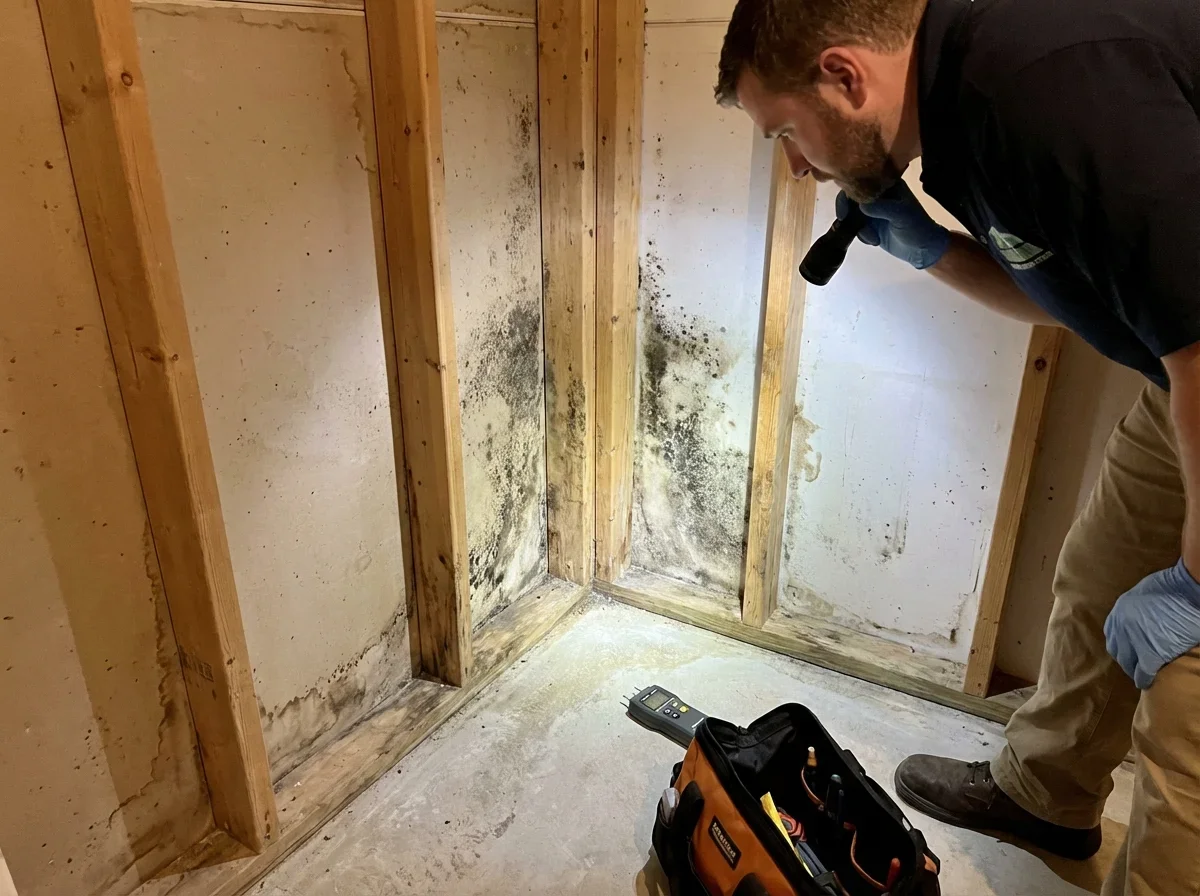
Choosing a Qualified Air Testing Professional in Texas
Texas requires anyone performing mold assessment to hold a valid TDLR Mold Assessment license. This includes air sampling.
Before you hire, verify credentials.
TDLR Licensing Requirements
Two relevant licenses exist:
- Mold Assessment Technician (individual license)
- Mold Assessment Company (business license)
Both the individual performing the work and the company they work for must be licensed. Check current status at tdlr.texas.gov/mol/mol.htm — unlicensed assessment work is illegal in Texas and voids any remediation warranties tied to that assessment.
If you're getting testing as part of a remediation project, make sure the assessor is independent.
A company holding both Mold Remediation and Mold Assessment licenses cannot perform both services on the same project under TMARR rules.
Accreditation and Lab Quality
Ask which lab the assessor uses for analysis. Reputable options include EMSL Analytical, ALS Environmental, and EMLab P&K. Labs should be AIHA-accredited (American Industrial Hygiene Association) for mold analysis.
Some fly-by-night companies use unaccredited labs or in-house "analysis" that's just visual inspection of slides without proper training.
Also ask whether the assessor is IICRC-certified (Institute of Inspection, Cleaning and Restoration Certification) or holds credentials like Certified Microbial Consultant (CMC) or Certified Indoor Environmentalist (CIE). These aren't legally required in Texas, but they indicate training beyond the minimum TDLR requirements.
Red Flags to Avoid
Walk away if the assessor:
- Offers to do both testing and remediation on the same project (TDLR violation)
- Pushes expensive pre-remediation air testing when you already have visible growth
- Can't provide a TDLR license number on request
- Uses scare tactics or claims mold is "toxic" to upsell services
- Doesn't collect an outdoor control sample
Some homeowners report being quoted $1,500+ for "comprehensive air quality panels" that include testing for VOCs, formaldehyde, and allergens that have nothing to do with mold.
Stick to what you actually need.
Understanding Air Sample Collection Methods
How the sample is collected matters almost as much as where it's collected. Poor technique skews results.
Proper Sampling Protocol
Air samples should be collected at breathing height (3-5 feet), away from supply vents and windows, in undisturbed conditions. The HVAC system should be running in normal mode (not off, not on fan-only).
Some assessors turn off HVAC for 30 minutes before sampling to get "worst case" readings, but this doesn't reflect actual living conditions.
Sample volume matters too. Spore trap pumps typically pull 75 liters over 5 minutes, but some pump faster or slower. Volume affects spore concentration calculations. Ask how many liters the pump is calibrated for and whether it's been recently calibrated — pumps drift over time.
Surface Sampling vs. Air Sampling
Some assessors also collect surface samples using tape lifts or swabs. These confirm mold presence on a specific surface but don't tell you anything about airborne spore levels.
Surface sampling is useful when you need to identify a specific colony type (like confirming Stachybotrys on a water-stained ceiling tile), but it's not a substitute for air testing if your concern is what you're breathing.
In Texas, surface sampling is often used in HVAC systems — swabbing the inside of supply ducts or the evaporator coil to check for growth. If you're dealing with suspected mold in air ducts, this approach makes more sense than whole-house air sampling.
Chain of Custody and Lab Turnaround
Samples should be shipped to the lab the same day they're collected (or next business day at latest) with proper chain-of-custody documentation. Standard turnaround is 5-7 business days.
If you're in the middle of a real estate transaction closing in three days, pay for rush service.
Some labs send preliminary results within 48 hours, then follow with a detailed report later. Ask about turnaround time before sampling — delays can stall remediation work or kill a home purchase deal.
When Air Testing Is Required by Insurance or Lenders
Some situations force your hand on testing even if you'd rather skip it.
Insurance Claims for Water Damage or Mold
Texas insurers increasingly require documentation before paying mold-related claims. If you're filing under your homeowner's policy for water damage that resulted in mold growth, the adjuster may demand pre-remediation and post-remediation air testing to establish baseline conditions and verify successful remediation.
Important: Most Texas homeowner policies exclude mold coverage unless the mold resulted from a covered peril like a sudden pipe burst or storm damage.
Gradual leaks, foundation seepage, and maintenance-related moisture issues are typically excluded. Read your policy's mold endorsement carefully — many cap mold coverage at $5,000-10,000 regardless of actual damage. More details in Does Homeowners Insurance Cover Mold in Texas?
FHA and VA Loan Appraisals
FHA and VA appraisers flag mold during home inspections, and underwriters may require remediation and clearance testing before approving the loan. This is especially common in older homes with visible staining or documented moisture issues.
If you're selling a home and the buyer is using FHA/VA financing, expect testing and remediation to become part of the transaction if mold is noted on the appraisal.
Conventional loans don't have the same hard requirements, but lenders can still condition loan approval on mold remediation if the appraiser or inspector raises concerns.
Alternatives and Complementary Diagnostics
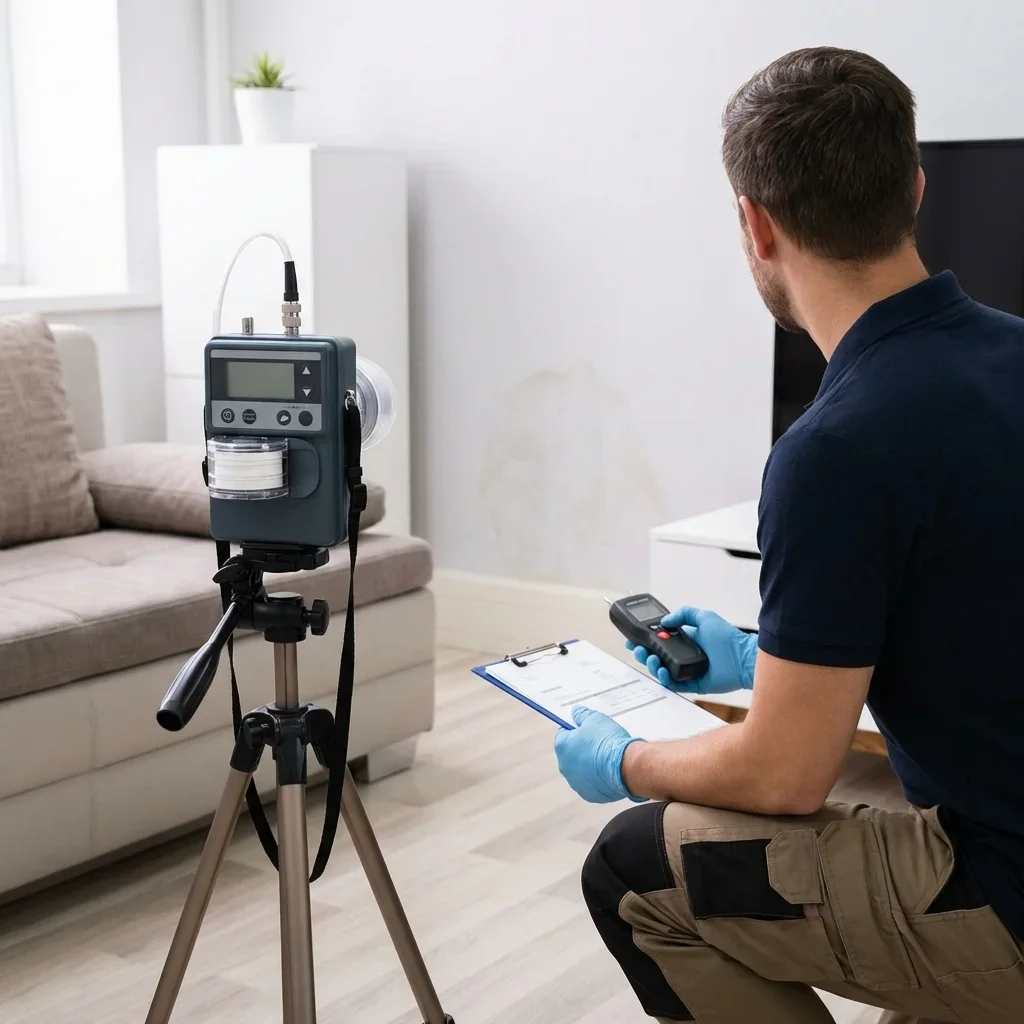
Air testing is one piece of the puzzle. Combine it with these other tools for a complete picture.
Moisture Mapping and Thermal Imaging
A competent assessor uses moisture meters (pin-type and pinless) to measure moisture content in drywall, flooring, and framing. Readings above 16% in wood or 1.5% in drywall signal conditions favorable for mold growth.
Infrared cameras detect temperature differentials that reveal hidden moisture — cold spots often indicate wet insulation or active leaks.
In Texas slab-on-grade homes, thermal imaging is especially useful for finding under-slab plumbing leaks that don't produce visible surface damage until mold has already colonized wall cavities.
Humidity and Dew Point Monitoring
Mold thrives above 60% relative humidity. A good assessment includes readings from different rooms using a calibrated hygrometer.
In Texas, summer indoor humidity above 55% (even with AC running) suggests undersized HVAC, duct leakage, or poor ventilation. Chronic high humidity enables mold growth even without a discrete water event.
Some assessors leave data loggers in place for 24-48 hours to capture humidity fluctuations and identify patterns (e.g., RH spikes every time the shower runs because the exhaust fan vents into the attic instead of outdoors).
Borescope Inspection of Wall Cavities
When moisture readings are elevated but you don't see surface mold, a borescope (inspection camera on a flexible cable) lets you look inside walls without major demolition. Assessors drill small test holes (usually near baseboards where patching is easy) and snake the camera through insulation to inspect the back side of drywall and framing.
This is common in wall cavity mold removal scenarios where the growth is hidden between studs.
It's invasive, but far less destructive than cutting open every suspect wall without confirmation.
Timing Your Air Quality Test for Best Results
When you test matters as much as how you test. Poor timing produces misleading data.
Seasonal Considerations in Texas
Outdoor mold spore counts in Texas peak from April through October during high humidity months. If you test in January when outdoor baseline is 1,500 spores/m³ and get an indoor reading of 4,000, that looks alarming.
But if you test in August when outdoor baseline is 18,000 spores/m³ and get an indoor reading of 5,000, you're actually below outdoor levels.
Some assessors prefer testing during peak spore season because it maximizes the chance of detecting hidden growth. Others prefer low-season testing because it reduces background noise. There's no perfect answer — just know that time of year affects interpretation.
After HVAC System Has Been Running
Air testing during the heating or cooling season (when HVAC runs regularly) gives you the most representative sample of what you're actually breathing day-to-day.
Testing with the system off produces artificially low counts because spores settle out of the air without circulation.
If your concern is HVAC-related mold, test while the system runs for at least 30 minutes beforehand to stir up any growth in ducts or on the evaporator coil. This is standard protocol for HVAC mold removal assessments.
Before and After Major Remediation Work
Pre-remediation testing is optional unless insurance or legal issues require it. Post-remediation clearance testing is strongly recommended to confirm the problem is actually solved.
Some homeowners skip clearance testing to save money, then wonder six months later if symptoms returning means the mold came back or if they're just dealing with seasonal allergies.
Clearance testing gives you a baseline you can refer back to if issues recur — particularly important in Texas where foundation movement and plumbing failures are chronic risks.
What to Do After You Get Air Test Results
You have the report. Spore counts are elevated.
Now what?
Work With a Licensed Remediation Contractor
If testing confirms a problem, hire a separate TDLR-licensed Mold Remediation Contractor (not the same company that did the assessment). Get at least two quotes. Scope of work should be based on the assessment report and follow IICRC S520 standards.
Expect the contractor to ask for the full assessment report including air test results, moisture readings, and photos.
This becomes the basis for their remediation protocol — containment strategy, affected materials, HEPA filtration plan, and clearance criteria.
Address the Moisture Source First
Mold remediation without fixing the underlying moisture problem is a waste of money.
If the air test pointed to elevated spores but your assessor didn't identify and document the moisture source, push back. You need to know whether it's a plumbing leak, roof penetration, foundation seepage, HVAC condensate overflow, or poor ventilation — and that issue must be corrected before or during remediation.
Texas homeowners frequently report mold coming back within months because the remediation contractor removed contaminated drywall but never fixed the leaking shower pan or corroded pipe that caused it.
Don't fall into that trap.
Retest After Remediation and Repairs
Post-remediation clearance testing should show indoor spore counts at or below outdoor baseline, with no elevated concentrations of water-damage indicator species.
If clearance testing still shows problems, the contractor needs to extend containment and continue remediation until levels normalize.
Some contracts tie final payment to passing clearance testing. Make sure this is spelled out in writing before work begins.
Consider Preventive Measures and Monitoring
Once you're clear, focus on keeping moisture controlled long-term. That might mean better attic ventilation, dehumidification, grading corrections, or regular HVAC maintenance.
Some Texas homeowners in high-risk areas (flood zones, pier-and-beam homes, older construction with cast-iron plumbing) invest in continuous humidity monitors and annual mold inspections as preventive maintenance.
Preventing the next occurrence costs far less than remediating the same problem twice.
- US Environmental Protection Agency (EPA). "Mold Testing or Sampling." https://www.epa.gov/mold/mold-testing-or-sampling. Accessed April 02, 2026.
- Centers for Disease Control and Prevention (CDC) / NIOSH. "Mold, Testing, and Remediation." https://www.cdc.gov/niosh/mold/testing-remediation/index.html. Accessed April 02, 2026.
- US Environmental Protection Agency (EPA). "Are there federal regulations or standards regarding mold?." https://www.epa.gov/mold/are-there-federal-regulations-or-standards-regarding-mold. Accessed April 02, 2026.